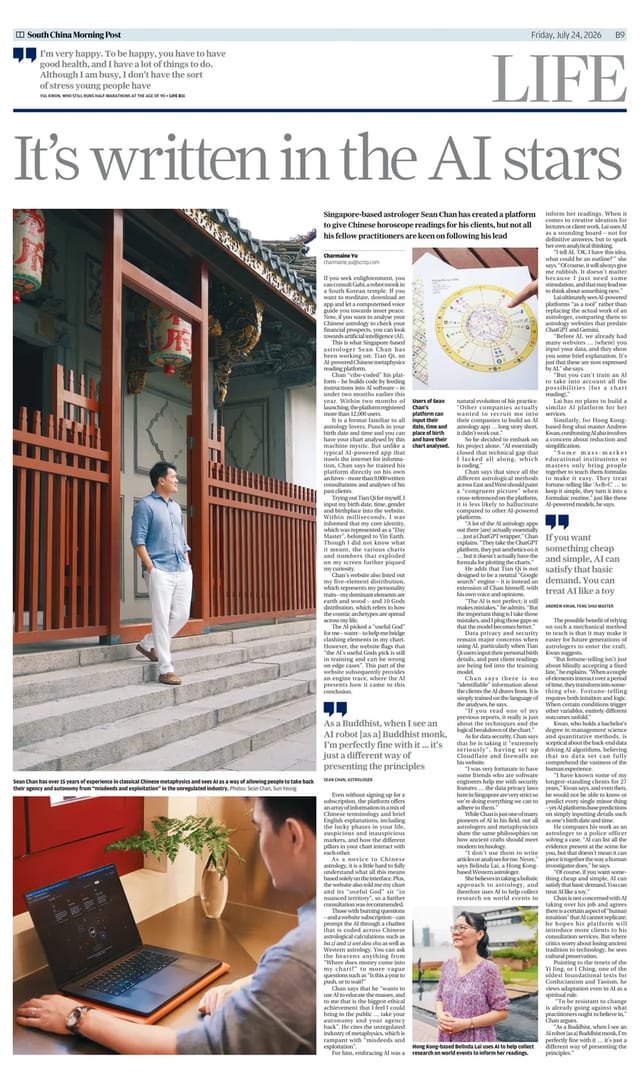
Sitting opposite the Self palace (命宮), this configuration occupies the Self–Travel (命遷線) and forms part of the inside–outside axis with Self: Spouse · Travel · Fortune · Self. Tai Yang transforms 化祿 under Geng (庚), 化權 under Xin (辛), 化忌 under Jia (甲); does not transform 化科.
Where Tai Yang sits in 遷移宮, the register typically reads through the public face and how mobility shapes opportunity — though the specific intensity depends heavily on supporting stars.
At textbook level, the configuration tends to produce teachers, broadcasters, politicians, sales leaders, religious figures, with the the public face and how mobility shapes opportunity taking on public-facing charisma. Tai Yang’s characteristic risk — over-extension when scope outruns warmth; reputation damage from the Jia (甲) 化忌 — surfaces specifically through travel and public reception when supporting conditions are absent. Pairings with Tian Liang reinforce this picture; pairings with the Four Killings (擎羊, 陀羅, 火星, 鈴星) sharing or opposing the palace can flip it.
Practitioners reading at depth weigh four further layers that this reference does not develop: which auxiliary stars (左輔, 右弼, 文昌, 文曲, 天魁, 天鉞) share or oppose the palace, whether any of the Four Killings (擎羊, 陀羅, 火星, 鈴星) sit in the same or opposing palace, whether self-transformations (自化) on adjacent palaces alter the configuration’s energy, and how the current 10-year and annual luck cycles activate or suppress what sits in the Travel Palace and the opposing Self Palace. Synthesising these layers across a real chart is the practitioner skill the Zi Wei Dou Shu Masterclass teaches.