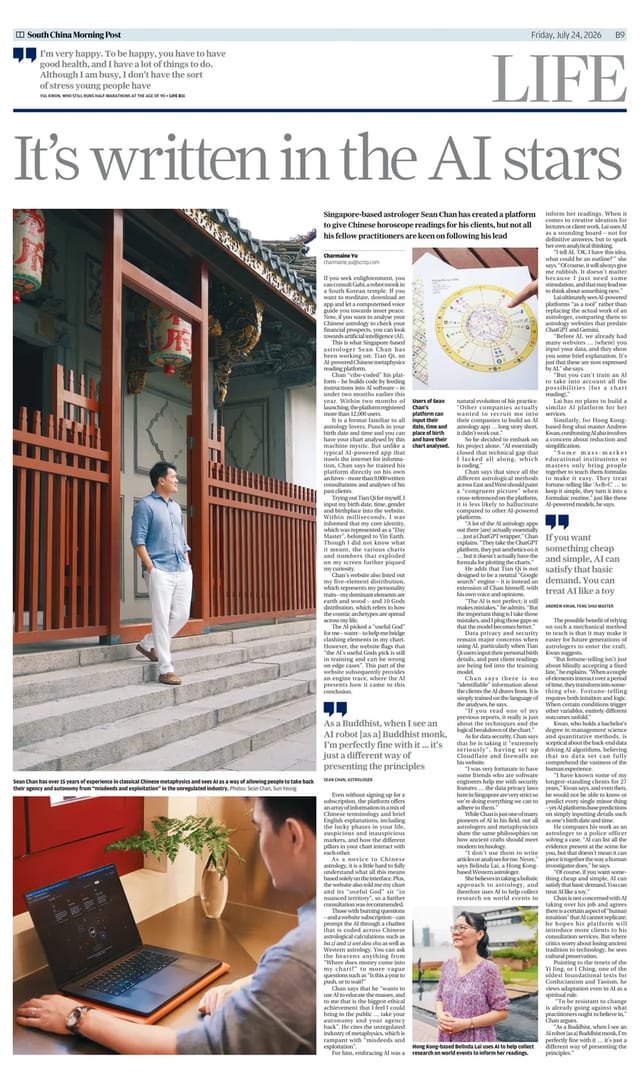
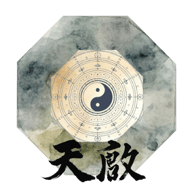
The configuration sits opposite the Career palace (官祿宮) on the Spouse–Career (夫妻–官祿線), with the trine reading drawing in Spouse, Travel, Fortune, Career. Tian Tong transforms 化祿 under Bing (丙), 化權 under Ding (丁), 化忌 under Geng (庚).
Classical commentary marks this configuration with 天同居夫妻, 安和諧美 (‘Tian Tong in the Spouse palace — peaceful, harmonious, beautiful’); 天同化祿在夫妻, 夫婦和諧 marks the Bing 化祿 case.
At the textbook level, Tian Tong in the Spouse Palace reads as comfort star — pleasure, ease, low-conflict warmth bringing its register to romantic partnership. Hospitality, family business, community-facing professions, work that prioritises wellbeing are common manifestations. Tian Tong’s characteristic risk — softness flattening into boredom; motivation erosion under Geng (庚) 化忌 — surfaces specifically through romantic partnership when supporting conditions are absent. Pairings with Tai Yin reinforce this picture; pairings with the Four Killings (擎羊, 陀羅, 火星, 鈴星) sharing or opposing the palace can flip it.
The four layers a practitioner-grade reading examines but this reference does not develop: which auxiliary stars (左輔, 右弼, 文昌, 文曲, 天魁, 天鉞) share or oppose the palace, whether any of the Four Killings (擎羊, 陀羅, 火星, 鈴星) sit in the same or opposing palace, whether self-transformations (自化) on adjacent palaces alter the configuration’s energy, and how the current 10-year and annual luck cycles activate or suppress what sits in the Spouse Palace and the opposing Career Palace. Synthesising these layers across a real chart is the practitioner skill the Zi Wei Dou Shu Masterclass teaches.