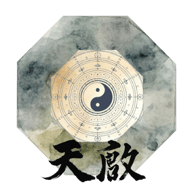
Hexagram #5, 需 Xū — Waiting — pairs the upper trigram of Water (坎) over the lower trigram of Heaven (乾). Strength held in reserve in the face of danger. The art of waiting with conviction — eating, drinking, staying inwardly steady — until the right moment arrives.
Decision quality
Wait. But wait while nourished and confident — not anxious. Cross the great water only when the signal is clear.
What this hexagram means
The upper trigram is Water (坎), ☵ — abysmal, danger, depth. The lower trigram is Heaven (乾), ☰ — creative, strong. The interplay of these two forces, with the upper sitting above the lower, is what gives this hexagram its character.
The classical Chinese name 需 (Xū) carries the connotations that the King Wen sequence assigned to position #5 in the order of change: Strength held in reserve in the face of danger. The art of waiting with conviction — eating, drinking, staying inwardly steady — until the right moment arrives.
This hexagram is also rendered in English as Nourishment, Attending, Waiting (Nourishment) — different translators emphasise different facets of its meaning.
What follows on this page is the full classical reading: the Judgment attributed to King Wen, the Image attributed to the Duke of Zhou, all six line texts, and the three derived hexagrams (互卦, 錯卦, 綜卦) that classical practitioners always read alongside the primary one. The page closes with a contemporary application section — how the configuration tends to land in modern decisions.
The Judgment (彖辭)
需:有孚,光亨,貞吉。利涉大川。
Waiting. If you are sincere, you have light and success. Perseverance brings good fortune. It furthers one to cross the great water.
The Judgment (彖辭) is the line attributed to King Wen, written while he was imprisoned by the last Shang ruler. It states the configuration’s essential character and indicates the favorable or unfavorable trajectory of the situation. For 需, it sets the time-quality of the moment: Strength held in reserve in the face of danger. The art of waiting with conviction — eating, drinking, staying inwardly steady — until the right moment arrives.
The decision quality the judgment recommends here is direct: Wait. But wait while nourished and confident — not anxious. Cross the great water only when the signal is clear.
The Image (大象傳)
雲上於天,需。君子以飲食宴樂。
Clouds rise up to heaven: the image of Waiting. Thus the noble person eats and drinks, is joyous and of good cheer.
The Image (大象傳, “Greater Image”) is the second classical layer, attributed to the Duke of Zhou. It takes the natural picture suggested by the two trigrams — water (坎, ☵) above heaven (乾, ☰) — and uses it to describe how the noble person (君子) responds. Image readings are a guide to right conduct: not what will happen, but what one ought to do.
For hexagram #5, the image points to a specific style of inner posture appropriate to this configuration. The classical formulation should be read as a behavioral instruction, not as a metaphor.
The six lines (爻辭)
Each hexagram has six lines (爻), counted from the bottom up. When you cast the I Ching using the traditional yarrow-stalk or three-coin method, certain lines emerge as “changing lines” — these are the ones whose line text (爻辭) speaks directly to your question. Below are all six line texts for hexagram 5 in classical Chinese with English rendering. If your reading produced a changing line, the relevant text is the one whose position matches.
Line position carries its own structural meaning: lines 2 and 5 are the “central” positions of their respective trigrams (and line 5 is the ruler’s position). Yang lines in odd positions and yin lines in even positions are “correct”; mismatches indicate friction.
First line · Bottom (Initial)
初九:需于郊,利用恆,无咎。
Initial Nine: Waiting in the meadow. It furthers one to abide in what endures. No blame.
Wait far from danger — in the meadow. Stay rooted in what endures; do not move toward the obstacle prematurely.
Second line · Second
九二:需于沙,小有言,終吉。
Nine in the Second: Waiting on the sand. There is some gossip. The end brings good fortune.
Wait closer in — on the sand. Some gossip; ignore it. The end is good if you keep your inner steadiness through the noise.
Third line · Third
九三:需于泥,致寇至。
Nine in the Third: Waiting in the mud brings about the arrival of the enemy.
Wait in the mud, and the enemy comes to you. Caution: you have moved too close to the obstacle and now it engages on its terms, not yours.
Fourth line · Fourth
六四:需于血,出自穴。
Six in the Fourth: Waiting in blood. Get out of the pit.
Wait in blood — get out of the pit. You are already wounded. Extraction is the only correct move; do not attempt to fight from a hole.
Fifth line · Fifth (Ruler)
九五:需于酒食,貞吉。
Nine in the Fifth: Waiting at meat and drink. Perseverance brings good fortune.
Wait at meat and drink — the right kind of waiting. Nourished, confident, unshaken. Perseverance brings good fortune.
Sixth line · Top
上六:入于穴,有不速之客三人來,敬之終吉。
Top Six: One falls into the pit. Three uninvited guests arrive. Honor them, and in the end there will be good fortune.
Three uninvited guests arrive in the pit; honor them. The unexpected is itself the answer. Receive what comes with courtesy, and the ending is good.
互卦 (Nuclear Hexagram) — the inner pattern
Whichever hexagram you cast, classical practice does not stop at the surface. The next thing you read is the 互卦 (hù guà) — the nuclear or mutual hexagram. Below is what it is for 需 Xū, and how to read its meaning.
Two opposing tendencies — fire flames upward, lake settles downward.
The 互卦 (Nuclear hexagram, sometimes also called the “mutual” or “inner” hexagram) is constructed from the inner four lines (lines 2, 3, 4, and 5) of the primary hexagram. Lines 2-3-4 form the new lower trigram; lines 3-4-5 form the new upper trigram. What it shows is the inner pattern of the situation — the structural undercurrent beneath the surface configuration.
The nuclear hexagram of 需 Xū is hexagram #38, 睽 Kuí — Opposition. Two opposing tendencies — fire flames upward, lake settles downward. Yet in opposition lies the seed of fertile difference.
What this means in practice: the surface configuration of Waiting is being driven, underneath, by the energetics of Opposition. When you act on this hexagram, the inner texture of your situation is shaped by the nuclear — so it is the nuclear, not just the primary, that you must respect.
錯卦 (Inverse Hexagram) — the polar opposite
The second derived reading is the 錯卦 (cuò guà) — the inverse or polar opposite. Every yang line becomes yin and every yin line becomes yang. The result is the configuration that lies on the other side of every choice in the primary.
The 錯卦 (Inverse, sometimes called “Opposite” or “Crossed”) is constructed by flipping every line of the primary hexagram — every yang becomes yin, every yin becomes yang. It is the hexagram’s polar opposite: the situation that would result if every active force became receptive and every receptive force became active.
The inverse of 需 Xū is hexagram #35, 晉 Jìn — Progress. Sunrise — light rising over the earth. Recognition arrives in waves; the prince is granted audience three times in a day.
Reading the inverse is how classical practitioners check their interpretation against its mirror. The wisdom of Waiting is sharpened by knowing what its absolute negation looks like — Progress is the warning, the contrast, or sometimes the secret complement of the primary configuration.
綜卦 (Reverse Hexagram) — the other side of the situation
The third derived reading is the 綜卦 (zōng guà) — the reverse or inverted hexagram. The whole figure is turned upside down. This is how the situation reads from the perspective of the other party, or how the same event would be described looking back from its conclusion.
The 綜卦 (Reverse, sometimes called “Inverted” or “Turned”) is constructed by turning the entire hexagram upside down — line 1 becomes line 6, line 2 becomes line 5, and so on. It is the situation seen from the other side — what the same event looks like to your counterpart, or what the same hexagram becomes when read from the top down rather than the bottom up.
The reverse of 需 Xū is hexagram #6, 訟 Sòng — Conflict. Two strong sides in collision. Even when you are right, prosecuting the conflict to the end destroys what you were defending.
In the King Wen sequence, 需 and 訟 sit as a paired set — one is the situation, the other is the situation viewed from the opposite end. When you read your own hexagram, your counterpart in the situation is reading the reverse. Knowing the 綜卦 is how you read both halves of the same event.
Modern application
In contemporary practice, hexagram 5 需 Xū tends to surface in readings around questions of:
pre-launch preparation
waiting out a market correction
holding position before action
trust in inner readiness
The decision-quality recommendation, distilled from the Judgment, the Image, and the line texts together, is: Wait. But wait while nourished and confident — not anxious. Cross the great water only when the signal is clear.
If you cast this hexagram and want to integrate its reading with your personal chart, the next step is to layer it onto your BaZi (Four Pillars) or Zi Wei Dou Shu profile — the same hexagram lands differently on a Yang Wood day master in a hot summer than it does on a Yin Water day master in winter. The I Ching tells you the shape of the moment; your BaZi tells you the terrain the shape will land on.
Hexagram 5 for career questions
For questions about career — promotions, role changes, business decisions, leaving or staying — hexagram 5 需 Xū (Waiting) describes the time-quality your professional situation is sitting in. Strength held in reserve in the face of danger. The art of waiting with conviction — eating, drinking, staying inwardly steady — until the right moment arrives.
The trigram configuration of Water above Heaven (abysmal, danger, depth over creative, strong) is the lens. Read the upper trigram (Water) as how your work appears to others — the visible shape of the role, the project, the public face. Read the lower trigram (Heaven) as the inner ground you are bringing to it — your competence, motivation, and disposition.
The decision-quality recommendation, distilled from the Judgment, applies directly to career deliberations: Wait. But wait while nourished and confident — not anxious. Cross the great water only when the signal is clear.
If your reading produced a changing line, the most career-relevant positions are line 5 (the ruler’s seat — how authority is moving above you) and line 2 (the worker’s central position — how your own role is moving). For hexagram 5, line 5 reads: 九五:需于酒食,貞吉。 — Nine in the Fifth: Waiting at meat and drink. Perseverance brings good fortune.
Hexagram 5 for love & relationship questions
For questions about relationships — love, family, friendship, partnerships, conflict — hexagram 5 需 Xū (Waiting) describes the energetic shape between the parties involved, regardless of which side asked the question. Strength held in reserve in the face of danger. The art of waiting with conviction — eating, drinking, staying inwardly steady — until the right moment arrives.
Read the configuration as a meeting of two forces: Water above Heaven (abysmal, danger, depth over creative, strong). The upper trigram (Water) describes how the situation looks from the outside between you, while the lower trigram (Heaven) describes the inner ground each person is bringing to the meeting. Misalignment between the two is often what the cast is pointing at.
The decision-quality recommendation, applied to the relational frame: Wait. But wait while nourished and confident — not anxious. Cross the great water only when the signal is clear.
If your reading produced changing lines, lines 2 and 5 are the most relationally significant — they are the central positions of the lower and upper trigrams respectively, and classical practice reads them as the “hearts” of each side of the relationship. The reverse hexagram (綜卦) is also worth reading for relationship questions: it shows the same situation from the other person’s perspective.
Hexagram 5 for decisions & choices
For questions about making a decision — whether to act, when to act, which option to choose, whether to wait — hexagram 5 需 Xū (Waiting) is among the most direct of the I Ching’s answers. The Judgment of every hexagram is, structurally, a recommendation about decision quality.
The decision recommendation for this configuration: Wait. But wait while nourished and confident — not anxious. Cross the great water only when the signal is clear.
If your reading produced a changing line, treat the line text as a more specific instruction within that overall recommendation. The line texts (爻辭) of hexagram 5 are the I Ching’s answer to the more granular form of your question; read the relevant line above (in the “The six lines” section) for the specific configuration of action your situation calls for. Line 5 (the ruler’s position) is the most authoritative line for decision questions when a clear path forward is needed.
For complex decisions, also read the inverse (錯卦) of this hexagram — it shows you the polar-opposite course of action, which is the test the I Ching uses for whether a recommendation is robust to its own negation.
Hexagram 5 for health & vitality questions
For questions about health and vitality, hexagram 5 需 Xū (Waiting) describes the energetic quality your body and mental state are operating in. Strength held in reserve in the face of danger. The art of waiting with conviction — eating, drinking, staying inwardly steady — until the right moment arrives.
In classical Chinese-medicine correspondences, the upper trigram (Water) governs the ear (TCM organ: kidneys), and the lower trigram (Heaven) governs the head (TCM organ: large intestine). For health questions, this hexagram’s configuration draws attention to those two channels in particular.
In Five-Element terms, the upper trigram is Water and the lower is Metal; the relation between these two elements (generative, controlling, or weakening) is part of how the hexagram lands on your specific BaZi chart.
The decision-quality recommendation, applied to health: Wait. But wait while nourished and confident — not anxious. Cross the great water only when the signal is clear. The I Ching does not diagnose, but it does indicate the time-quality of recovery, depletion, or balance — which is exactly what classical practitioners read it for in medical contexts. Layer this reading onto your BaZi (Four Pillars) chart to see how the hexagram’s elemental configuration interacts with your day master’s elemental balance — the same hexagram lands very differently on a hot-summer Yang Wood than it does on a winter-frozen Yin Water.
Frequently asked questions
What does I Ching hexagram 5 (需 Xū) mean?
Strength held in reserve in the face of danger. The art of waiting with conviction — eating, drinking, staying inwardly steady — until the right moment arrives. The Wilhelm/Baynes English rendering is “Waiting.” It is composed of the upper trigram Water (坎) over the lower trigram Heaven (乾). The decision quality of the configuration: Wait. But wait while nourished and confident — not anxious. Cross the great water only when the signal is clear.
What is the 互卦 (nuclear hexagram) of 需?
The nuclear hexagram (互卦, hù guà) of 需 is hexagram #38, 睽 Kuí — Opposition. It is constructed by taking lines 2, 3, 4 of the primary as the new lower trigram, and lines 3, 4, 5 as the new upper trigram. It reveals the inner pattern hidden inside the situation.
What is the 錯卦 (inverse hexagram) of 需?
The inverse hexagram (錯卦, cuò guà) of 需 is hexagram #35, 晉 Jìn — Progress. It is constructed by flipping every line: every yang becomes yin and every yin becomes yang. It shows the polar opposite of the primary configuration.
What is the 綜卦 (reverse hexagram) of 需?
The reverse hexagram (綜卦, zōng guà) of 需 is hexagram #6, 訟 Sòng — Conflict. It is constructed by turning the entire hexagram upside down — reading from line 6 down to line 1. It shows the situation viewed from the other side, often the perspective of your counterpart in the same event.
How is hexagram 5 cast or chosen?
The classical methods are the yarrow-stalk method (described in the Great Treatise of the I Ching) and the simpler three-coin method. Both produce six lines — some “old” (changing) and some “young” (stable). The hexagram you cast is read first; if there are changing lines, their line texts (爻辭) speak directly to your question, and the hexagram resulting from the changes is read as the future trajectory.
For a guided personal reading in the context of your BaZi or ZWDS chart, book a consultation.
Try the Oracle
Cast a hexagram for your own question
Hold a question in mind and throw the classical three-coin oracle. The cast comes back with full classical interpretation, the changing lines that are speaking to your question, and the second hexagram showing the trajectory.
Get a personal Yi Jing reading from Master Sean Chan
Bring a specific decision or situation. We will cast a hexagram, read the lines that are speaking to you, and integrate the reading with your BaZi or ZWDS chart.
King Wen pair (5–6): Hexagram 5 需(this page) is paired with 訟#6 Conflict. In the King Wen sequence, the two hexagrams in this pair are the same line pattern read in opposite directions — 綜卦 (reverse) of one another. Many classical commentators read them together as “the same situation viewed from the two sides.”
Not one system, but three. Tian Qi reads your chart across BaZi, Zi Wei Dou Shu, and Qi Men Dun Jia at once, then cross-checks every engine, so your answer is verified and layered. Master-level clarity in minutes.
A true tri-engine mind that checks its own analysis across all three systems
Your BaZi Four Pillars decoded: day master, ten gods, and the forces shaping your life
Zi Wei read palace by palace, and Qi Men to time your biggest decisions
One AI reading your chart across BaZi, Zi Wei Dou Shu, and Qi Men Dun Jia at once. Master-level clarity in minutes.