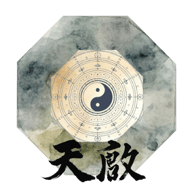
乾 (Qián, “Heaven”) is the trigram of creative, strong. Pure yang (three solid lines), it is the “Father” of the eight-trigram family and corresponds to Metal (金) in the Five-Element system.
What this trigram means
乾 (Qián) is the trigram of three unbroken yang lines — pure creative force, the most active configuration in the entire I Ching. Its image is Heaven (天), the canopy of sky that does not rest, that turns through its full cycle without pausing. Among the eight trigrams, 乾 is the “Father,” the originating principle from which the other seven derive their relations.
The classical phrase that captures its character is 天行健,君子以自強不息 — “The movement of Heaven is full of power; thus the noble person makes himself strong and untiring.” This is the line from the Image (大象) of hexagram #1, where 乾 doubles itself. The trigram’s mode is to act, originate, and persist. Where it appears in a hexagram — whether above or below — it brings the quality of pure initiative.
In the family of trigrams, 乾 is paired with 坤 (Kun, Earth) as its complement. The two together form the cosmological poles: Heaven gives form to time, Earth gives form to space; Heaven initiates, Earth completes. Every other trigram is a partial mixture of these two extremes. To understand 乾 is to understand the unmixed yang principle in its purest expression.
The line composition
乾 (Qián) is built from three horizontal lines, each either yang (solid, ⚊) or yin (broken, ⚋). The order in which the lines appear from bottom to top is what gives the trigram its character. For 乾, the configuration is:
乾 ☰ — line pattern (read bottom-up)
top (line 3): yang (solid line, ⚊) middle (line 2): yang (solid line, ⚊) bottom (line 1): yang (solid line, ⚊)
The pattern is pure yang (three solid lines). Reading bottom-up is how trigrams are always cast and read in the I Ching tradition — line 1 is the foundation, line 3 is the surface that meets the world above.
The classical source: 說卦傳 (Shuogua Zhuan)
The classical source for the meanings of the eight trigrams is the 說卦傳 (Shuogua Zhuan, “Discussion of the Trigrams”), one of the Ten Wings (十翼) appended to the Zhou Yi. The Shuogua catalogues the natural phenomena, body parts, animals, and human types attributed to each trigram. Below is the canonical Shuogua passage for 乾:
乾為天,為圜,為君,為父,為玉,為金,為寒,為冰,為大赤,為良馬,為老馬,為瘠馬,為駁馬,為木果。
Qian is heaven; it is the circle, the ruler, the father, jade, metal, cold, ice, deep red. Among horses, it is the fine horse, the old horse, the lean horse, the wild horse. Among trees, it is the firm-fruited tree.
The Shuogua attributions are not arbitrary — they are read as a coherent extension of the trigram’s essential character. Where the trigram is, the things on the list belong: Heaven as creative, strong extends to the head (the body part it governs), the horse (its representative animal), and the northwest (its quadrant in the Post-Heaven Bagua). Each of these is a different lens onto the same archetypal pattern.
In a hexagram reading, knowing the Shuogua attributions lets you translate an abstract line pattern into concrete imagery. If the upper trigram of your hexagram is 乾, then the question what is above the situation can be answered with any of these images, depending on which fits the question you are asking.
As the upper trigram — eight hexagrams
乾 appears as the upper trigram in eight of the 64 hexagrams — one for each possible lower trigram. When 乾 is on top, its quality (creative, strong) describes the outer face of the situation: what is visible, what is publicly happening, the surface configuration. The lower trigram in each pairing modifies that outer face with the inner ground from which it emerges.
乾 appears as the lower trigram in eight of the 64 hexagrams. When 乾 is below, its quality describes the inner ground of the situation: the foundation, the disposition of the person inside the hexagram, the energy from which the upper trigram’s outer expression rises.
Eight of the 64 hexagrams are formed by doubling a single trigram — placing the same trigram both above and below itself. These are sometimes called the eight “pure” or “doubled” hexagrams, and they occupy a special structural place in the system: each one is the maximal expression of a single trigram’s nature, undiluted by any contrasting force.
For 乾, the doubled hexagram is hexagram #1: 乾 Qián — The Creative. Pure creative force. The yang principle in its undiluted, generative form — sustained, tireless action that initiates and sets cycles in motion. If you cast this hexagram, the time-quality of Heaven (creative, strong) is operating at its full strength, with no admixture from any other trigram.
The eight trigrams are arranged in two distinct circular sequences in classical Chinese cosmology: the Pre-Heaven Bagua (先天八卦, attributed to the legendary Fu Xi 伏羲) and the Post-Heaven Bagua (後天八卦, attributed to King Wen 文王). The two diagrams place the trigrams in different positions because they are reading different things.
The Pre-Heaven sequence is an ideal, time-out-of-time arrangement that pairs the trigrams as polar opposites: 乾 opposite 坤, 離 opposite 坎, 震 opposite 巽, 艮 opposite 兌. It describes the trigrams in their archetypal relations, before any seasonal or geographical specialisation. 乾 sits in the South of the Pre-Heaven Bagua.
The Post-Heaven sequence is the arrangement that practitioners actually use in BaZi, Feng Shui, and the I Ching. It maps the eight trigrams onto the seasonal year: 乾 sits in the Northwest of the Post-Heaven Bagua, corresponding to late autumn into early winter. This is the position you use when reading the trigram’s active influence on the world.
The two sequences are not in conflict. Pre-Heaven describes what Heaven is; Post-Heaven describes when and where Heaven acts. Classical practitioners hold both diagrams in mind and switch between them depending on the question.
Five Element & correspondence table
In the Five-Element (五行) system that overlays the I Ching with BaZi and Feng Shui, 乾 is classified as Metal (金). This is the same Five-Element classification used to read seasonal energies, organ correspondences, and the elemental relations between two BaZi day masters. Within the I Ching itself, 乾 carries the following classical correspondences:
Body part: Head (the part of the human body that the trigram governs in classical Chinese medicine and Yi medicine)
Internal organ: Large intestine (the organ in TCM that resonates with the trigram’s element and direction)
Representative animal: Horse (the animal whose nature embodies the trigram’s archetypal motion)
Family member: Father (the position in the eight-trigram family, with 乾 as Father and 坤 as Mother and the other six trigrams as their three pairs of sons and daughters)
Season: Late autumn into early winter (the time of year when the trigram’s energy is dominant in the Post-Heaven Bagua)
These correspondences are how a single trigram — an abstract three-line figure — becomes useful across multiple traditions. The same 乾 that you cast in an I Ching reading is the 乾 that maps to a direction in your Feng Shui chart, an organ in your TCM diagnosis, and an element in your BaZi pillars.
Modern application
In contemporary practice, 乾 (Heaven) is most useful as a diagnostic lens: when you find this trigram in a hexagram you have cast, the question becomes where in this situation is the quality of creative, strong acting? If it is the upper trigram, the surface of the situation has that quality. If it is the lower, the inner disposition does. If it appears in the nuclear hexagram (互卦), the structural undercurrent does.
乾 is also a useful frame for non-divinatory work. In coaching, strategy, and decision-making, asking “is this a moment of creative, strong?” gives you a classical test for whether the configuration you are facing matches the time-quality the trigram describes. If it does, the hexagrams in which 乾 appears as the upper trigram (such as #1 The Creative, #6 Conflict, #10 Treading (Conduct)) are worth reading even without a formal cast.
For a personal reading that integrates the trigrams with your BaZi (Four Pillars) chart, 乾 layers onto your day master and current luck pillar to show how this archetypal force is acting on you specifically — the same trigram lands very differently on a Metal-friendly chart than on one where Metal is unwelcome.
Frequently asked questions
What does the I Ching trigram 乾 (Qián, Heaven) mean?
乾 is the trigram of creative, strong. Pure yang (three solid lines), it is one of the eight trigrams (八卦) that combine in pairs to produce the 64 hexagrams of the I Ching. Its image is Heaven. In the Five-Element system it corresponds to Metal (金), and in the family of trigrams it is the Father.
Which I Ching hexagrams contain 乾 as the upper trigram?
乾 appears as the upper trigram in eight of the 64 hexagrams: hexagrams 1 (乾), 6 (訟), 10 (履), 12 (否), 13 (同人), 25 (無妄), 33 (遯), 44 (姤). When 乾 is the upper trigram, its quality describes the outer face of the situation — what is publicly visible.
Which I Ching hexagrams contain 乾 as the lower trigram?
乾 appears as the lower trigram in eight hexagrams: hexagrams 1 (乾), 5 (需), 9 (小畜), 11 (泰), 14 (大有), 26 (大畜), 34 (大壯), 43 (夬). When 乾 is the lower trigram, its quality describes the inner ground of the situation — the disposition of the person at the centre of the hexagram.
What is 乾's position in the Post-Heaven Bagua?
In the Post-Heaven Bagua (後天八卦, the arrangement attributed to King Wen and used in Feng Shui and BaZi), 乾 sits in the Northwest. This corresponds to late autumn into early winter in the seasonal cycle. In the Pre-Heaven Bagua (先天八卦, the older Fu Xi arrangement), 乾 sits in the South.
What hexagram is formed when 乾 doubles itself?
When 乾 is placed both above and below itself, the result is hexagram #1, 乾 Qián — The Creative. This is one of the eight “pure” or “doubled” hexagrams in the I Ching, where the trigram’s essential nature is amplified rather than tempered by another trigram. Pure creative force. The yang principle in its undiluted, generative form — sustained, tireless action that initiates and sets cycles in motion.
What is the difference between Pre-Heaven and Post-Heaven Bagua, and why does 乾 sit in different positions?
The Pre-Heaven Bagua (先天八卦) is attributed to Fu Xi and arranges the trigrams in pairs of polar opposites — an idealised, time-out-of-time configuration. The Post-Heaven Bagua (後天八卦) is attributed to King Wen and arranges the trigrams along the seasonal year, which is the diagram practitioners use in BaZi, Feng Shui, and the I Ching itself. The two arrangements are not in conflict: Pre-Heaven describes what each trigram is, while Post-Heaven describes when and where each trigram acts.
Try the Oracle
Cast a hexagram for your own question
Hold a question in mind and throw the classical three-coin oracle. The cast comes back with full classical interpretation, the changing lines that are speaking to your question, and the second hexagram showing the trajectory.
Get a personal Yi Jing reading from Master Sean Chan
Bring a specific decision or situation. We will cast a hexagram, read the lines that are speaking to you, and integrate the reading with your BaZi or ZWDS chart.
Not one system, but three. Tian Qi reads your chart across BaZi, Zi Wei Dou Shu, and Qi Men Dun Jia at once, then cross-checks every engine, so your answer is verified and layered. Master-level clarity in minutes.
A true tri-engine mind that checks its own analysis across all three systems
Your BaZi Four Pillars decoded: day master, ten gods, and the forces shaping your life
Zi Wei read palace by palace, and Qi Men to time your biggest decisions
One AI reading your chart across BaZi, Zi Wei Dou Shu, and Qi Men Dun Jia at once. Master-level clarity in minutes.