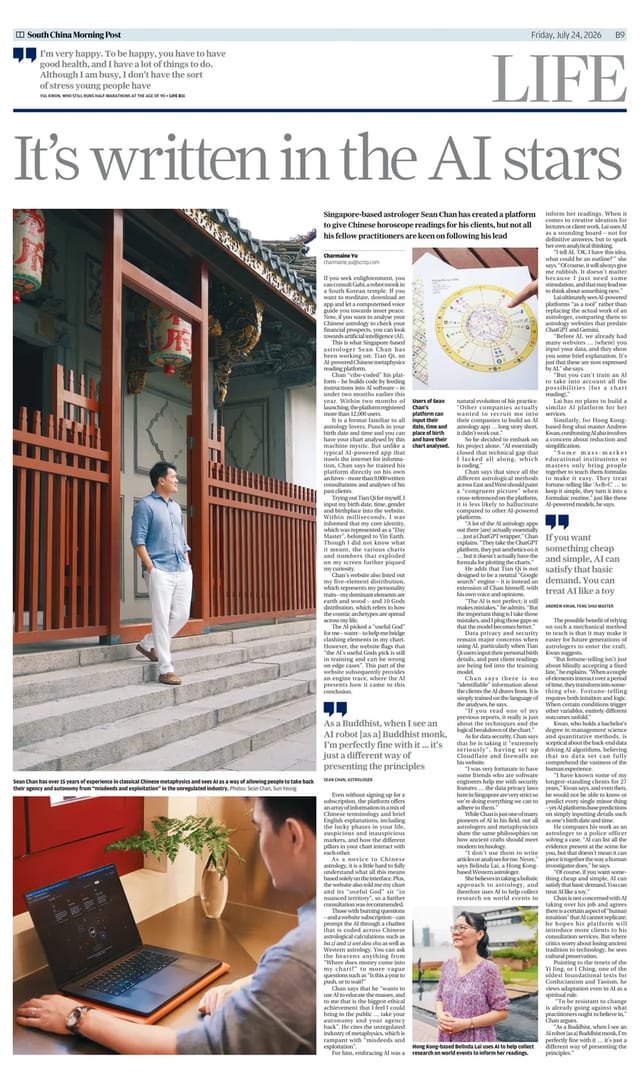
An online cast of the Yi Jing (易經) using the classical three-coin method. Hold a question in mind, throw six lines, and read your hexagram with full Wilhelm/Baynes commentary, changing-line interpretation, and the second hexagram that shows the trajectory of the situation.
Reading by Master Sean Chan · Singapore-based Chinese metaphysics consultant
I CHING · 易經 · CAST A HEXAGRAM
Take a breath. Hold one clear question in mind.
The I Ching has been counsel to seekers for three thousand years. The classical three-coin method below builds your hexagram from the bottom up — six throws, each one a line. If a line comes up changing, it is speaking directly to your question, and the hexagram you cast transforms into a second hexagram showing the trajectory.
EXAMPLE
This is what your cast will look like.
泰 Hexagram 11 — Peace
Heaven and earth united — the rare moment when the small departs and the great approaches.
A copper line means a changing line — that line’s text speaks to the question, and the hexagram transforms into a second one.
The three-coin method is the most widely used way to cast the I Ching. Each line of the six-line hexagram is built from one throw of three coins: heads counts 3, tails counts 2. Sum the three coins and you get a value of 6, 7, 8, or 9.
Values 6 and 9 are old (changing) lines — old yin (6) becomes yang in the second hexagram, and old yang (9) becomes yin. Values 7 and 8 are young (stable) lines that stay the same. The hexagram is read bottom-up: throw 1 is line 1 (the foundation), throw 6 is line 6 (the surface).
If your cast produced changing lines, those are the lines speaking directly to your question. The hexagram itself describes the present configuration; the second hexagram (after the changes) describes the trajectory.
Why cast the I Ching?
The I Ching (易經, also romanised Yi Jing or Yijing) is the oldest of the Chinese classics — a divinatory and philosophical text whose core was in use by 1000 BCE and whose Ten Wings (十翼), the canonical commentaries traditionally attributed to Confucius and his school, were complete by the Han dynasty. For three thousand years it has been consulted by people facing genuine decisions: rulers planning campaigns, scholars choosing whether to take office, ordinary people deciding whether to marry, move, build, or wait.
The I Ching is not a fortune-telling device. It does not predict what will happen. What it gives you is a structural reading of the moment — an answer to the question "what is the time-quality of the situation I am in, and what mode of action does that quality call for?" The 64 hexagrams are 64 archetypal configurations of yin and yang — 64 ways the world can hold itself at a given moment — and the cast tells you which configuration applies to your specific question.
In contemporary practice the I Ching is used most often for decisions where the data is incomplete and the right path is genuinely unclear: a career change, a relationship at a turning point, a venture with both promise and risk, a difficult conversation. Casting the hexagram does not relieve you of the need to decide. It gives you a frame — classical, elegant, and surprisingly specific — in which to think more carefully about what you already know.
How to read your cast
The cast comes back with up to four pieces: the primary hexagram you threw, any changing lines, the texts of those changing lines, and a second hexagram formed when the changing lines transform into their opposites. Classical practitioners read these four together, not in isolation.
1. The primary hexagram is the situation
The primary hexagram describes the present configuration of the matter you asked about. Its name, classical Chinese title, and Wilhelm/Baynes English rendering set the overall character — whether the time-quality is one of difficulty, abundance, retreat, advance, opposition, peace, and so on. The first thing to do with any cast is sit with the primary hexagram’s name and let its image work on the question you asked.
2. Changing lines are the lines speaking with extra weight
If your cast produced changing lines (any line summing to 6 or 9 in the three-coin method), those are the specific lines speaking directly to your question. Read each changing line text in order, bottom-up — line 1 first, line 6 last. Each line has a position-meaning (line 1 is the foundation of the situation; line 5 is the ruler’s seat; line 6 is the surface, the part that meets the world) and the line text itself, which is often a vivid concrete image.
3. The second hexagram is the trajectory
When changing lines flip from yin to yang or yang to yin, they reshape the original hexagram into a second one. This second hexagram is the trajectory: the configuration the situation is moving toward as the changing lines complete their motion. The two hexagrams together — primary and second — tell a story: this is where you are, this is where it is going.
4. A stable cast is also an answer
If no lines came up as changing (no 6s, no 9s), the cast is stable. There is no second hexagram. The reading is the primary hexagram alone, considered as the present configuration without movement. None of the lines are speaking with extra weight; the whole picture is the answer. A stable cast is not a less complete one — it is a different kind of answer, and the absence of motion is itself information.
5. Layer the cast onto your personal chart
For consultation work, the I Ching reading is layered on top of the questioner’s BaZi (Four Pillars) or Zi Wei Dou Shu chart. The same hexagram lands very differently on a Yang Wood day master in a hot summer luck pillar than on a Yin Water day master in winter. The hexagram tells you the shape of the moment; your chart tells you the terrain the shape is landing on.
Three-coin or yarrow-stalk method?
The two classical methods for casting the I Ching are the three-coin method and the yarrow-stalk method. Both have been used by serious practitioners for centuries; both produce a valid hexagram with valid changing lines. The cast tool above uses the three-coin method — simpler, faster, and the way most contemporary casters work.
The two methods produce different probability distributions. The three-coin method gives old yin (6) : young yang (7) : young yin (8) : old yang (9) at 1 : 3 : 3 : 1 — meaning roughly a quarter of all lines come up as changing. The yarrow-stalk method gives the same four values at 3 : 5 : 7 : 1, weighted differently, with fewer changing lines on average. Yarrow stalks are also a substantially longer ritual: traditionally fifty stalks, divided and counted in three rounds per line, six lines per cast, taking ten to fifteen minutes of focused work.
Neither method is more "accurate" than the other. The three-coin method is what you use when you want to consult the oracle quickly and contemporaneously, with the question fresh. The yarrow-stalk method is what you use when the question deserves the full ritual time — a major life decision, a question about which a wrong answer would be costly. Both methods, properly performed, give you the same kind of structural reading; they just shape the casting experience differently.
Frequently asked questions
How does the three-coin method of casting the I Ching work?
Each of the six lines of the hexagram is built from one throw of three coins. Heads counts 3, tails counts 2. Sum the three coins and you get a value of 6, 7, 8, or 9. Values 6 and 9 are old (changing) lines; 7 and 8 are young (stable) lines. The hexagram is read bottom-up: throw 1 is line 1 (the foundation), throw 6 is line 6 (the surface that meets the world).
What are changing lines in an I Ching reading?
Changing lines are lines that came up old yin (sum 6) or old yang (sum 9). They are the lines speaking directly to your question. Read their texts in order, bottom-up. The hexagram you cast describes the present configuration; the second hexagram (formed when the changing lines transform into their opposites) describes the trajectory the situation is moving toward.
What if my cast has no changing lines?
If all six lines are young (7 or 8), the hexagram is stable — the present configuration without movement. None of the lines are speaking with extra weight; the whole picture is the answer. There is no second hexagram in a stable cast because no lines are changing. The absence of movement is itself information.
Is the three-coin method as accurate as the yarrow-stalk method?
Both methods are classical and both produce a valid I Ching reading. The three-coin method gives roughly equal probability to old yin (6), young yang (7), young yin (8), and old yang (9) at 1 : 3 : 3 : 1; the yarrow-stalk method gives the same four values weighted 3 : 5 : 7 : 1, producing fewer changing lines on average. Neither method is more accurate; they shape the experience differently.
Do I need to ask a specific question to cast the I Ching?
No, but it is the traditional practice. A specific question gives the hexagram a definite situation to address. If you cast without a question, read the hexagram as a description of the time-quality you are sitting in — the present moment of your life as a whole. The cast tool keeps your question private (we never store it server-side, only forward it to your own email if you choose).
Can I share my cast with someone else?
Yes. After casting, the Share button generates a permalink that anyone can open to see the same hexagram and changing lines you cast. You can also have the cast emailed to yourself via the Email button; the email contains the full classical commentary plus links to the long-form reading of each hexagram involved.
Does the I Ching predict the future?
No, in the strict sense. The I Ching describes the structural quality of the present moment and the trajectory the moment is on if its forces continue uninterrupted. It does not predict events. What it does is give you a frame for reading the situation accurately so that the decision you make is informed by the actual configuration, not by what you would prefer the configuration to be.
Master Sean Chan
Chinese Metaphysics Consultant · Singapore
Master Sean Chan is Singapore’s leading Chinese metaphysics consultant with 15+ years of experience and over 8,500 clients served. A graduate of NUS Business School and the University Scholars Programme, he is self-taught in classical Chinese metaphysics and specialises in BaZi, Zi Wei Dou Shu, Qi Men Dun Jia, and Feng Shui. His work has been featured in CNA, The Straits Times, Harper’s Bazaar, Lianhe Zaobao, and Rice Media.
Not one system, but three. Tian Qi reads your chart across BaZi, Zi Wei Dou Shu, and Qi Men Dun Jia at once, then cross-checks every engine, so your answer is verified and layered. Master-level clarity in minutes.
A true tri-engine mind that checks its own analysis across all three systems
Your BaZi Four Pillars decoded: day master, ten gods, and the forces shaping your life
Zi Wei read palace by palace, and Qi Men to time your biggest decisions
One AI reading your chart across BaZi, Zi Wei Dou Shu, and Qi Men Dun Jia at once. Master-level clarity in minutes.