Most histories of BaZi (八字, the "Eight Characters", also called the Four Pillars of Destiny) begin with a sage. A legendary emperor receives the stems and branches, or a hermit on a mountain hands down a secret book, and the story jumps straight to a list of famous texts.
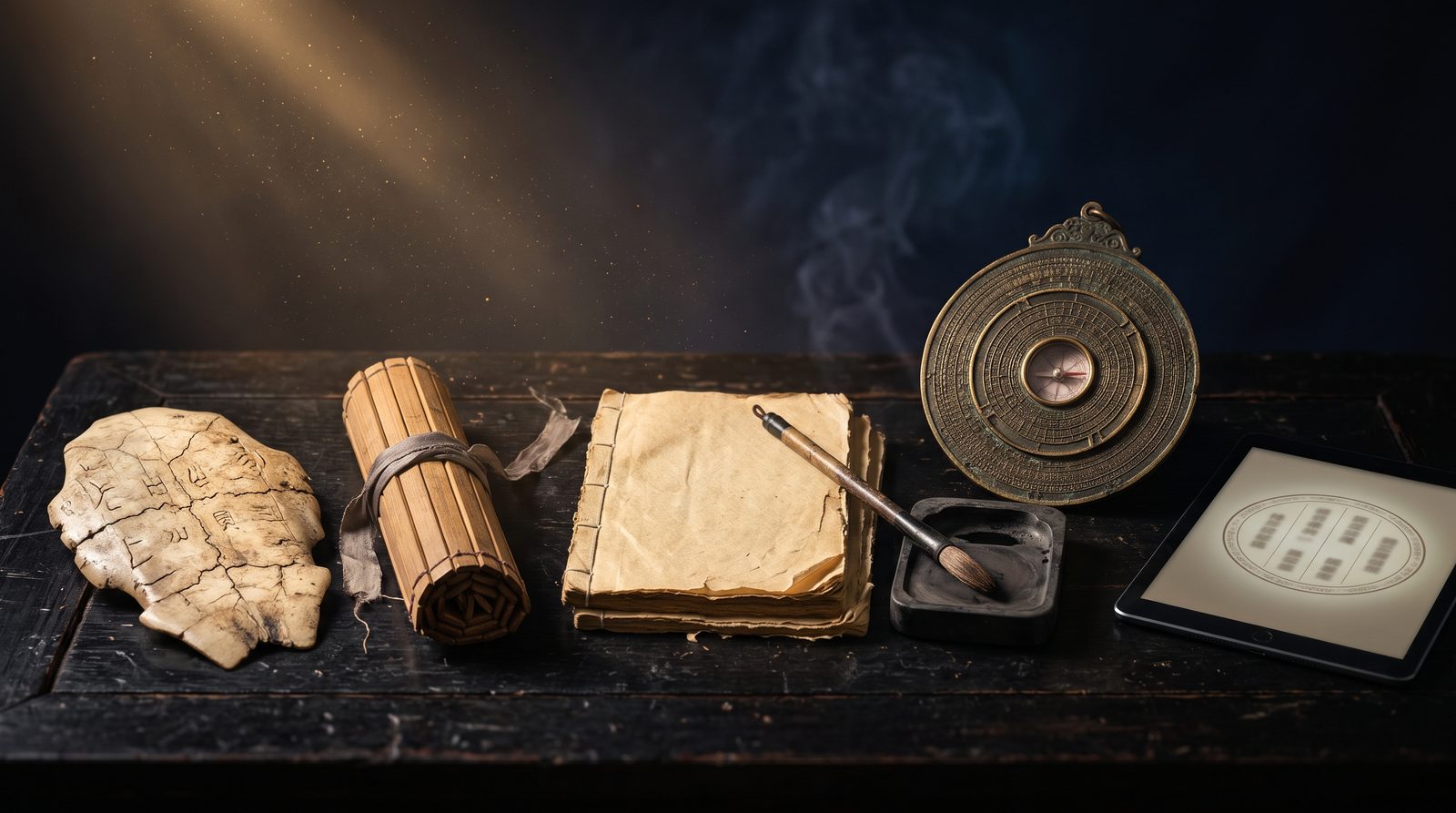
The real history is more interesting than the legend, and it is better documented than most people realise. BaZi did not arrive complete. It was assembled over roughly three thousand years, from a counting system scratched onto bones, through tomb almanacs that told parents what a child's birth day meant, to the reading method that practitioners still use today. Each stage left physical evidence: inscriptions, excavated bamboo slips, epitaphs, imperial catalogues and printed books.
This guide follows that evidence. Where a story is legend, or where an author is only traditionally credited with a book, I say so. Knowing which parts of the tradition are solid, and which are attributions, is not academic hair-splitting. It changes how you read a chart.
Key takeaways
- BaZi is about 1,000 years old in its modern form, but it is built on a stem-and-branch calendar more than 3,000 years old.
- The calendar came first. Shang oracle bones (c. 1250–1046 BCE) name days in the same 60-term cycle that a BaZi chart uses today.
- Birth-day fortune-telling is attested by about 217 BCE, in Qin tomb almanacs excavated at Shuihudi in 1975.
- The Tang dynasty read three pillars (year, month, day). Li Xuzhong (761–813) is the best-documented practitioner.
- The Song dynasty made it BaZi. The hour pillar became standard and the Day Stem became the self, the method credited to Xu Ziping.
- Several famous attributions are uncertain, including Liu Bowen's link to the Ditian Sui.
BaZi history timeline at a glance
| Period | Approx. dates | What changed | How we know |
|---|---|---|---|
| Shang dynasty | c. 1250–1046 BCE | The 60-term cycle of stems and branches is used to name days | Oracle-bone inscriptions, including bones carved with the full 60-day table |
| Zhou to Warring States | c. 1046–221 BCE | Yin-yang and the Five Phases (五行) become a theory of how qi changes | Received philosophical texts; the Five Phases are systematised by the 3rd century BCE |
| Qin and Han | 221 BCE–220 CE | Almanacs read a child's prospects from the day of birth; the 60-cycle is applied to years; the idea that fate is fixed by the qi received at birth is argued in writing | Excavated daybooks (日書) such as those from Shuihudi; Wang Chong's Lunheng |
| Tang dynasty | 618–907 | Readers use year, month and day of birth together: a three-pillar method | Han Yu's epitaph for Li Xuzhong; Lü Cai's critique preserved in the Old Book of Tang |
| Five Dynasties and Song | 907–1279 | The hour becomes standard and the Day Stem becomes the self (日主, the Day Master): the "Ziping" method | Song-era manuals, later compiled in Yuanhai Ziping |
| Ming dynasty | 1368–1644 | Encyclopaedias gather and standardise the rules; theories of balance and remedy mature | Sanming Tonghui, Shenfeng Tongkao |
| Qing dynasty | 1644–1912 | Structure (格局) theory is refined; the imperial library catalogues fate books | Ziping Zhenquan; the Siku Quanshu catalogue |
| Republic of China | 1912–1949 | Professional writers edit, annotate and print the classics for a mass readership | Editions by Xu Lewu, Yuan Shushan and Wei Qianli |
| 1949 to now | — | Suppression on the mainland, survival in Hong Kong, Taiwan and Southeast Asia, global revival, and finally calculation by computer | Modern scholarship and ethnography; software |
What is BaZi?
A BaZi chart turns the moment of birth into four pairs of characters, one pair each for the year, month, day and hour. Each pair has a Heavenly Stem (天干) above and an Earthly Branch (地支) below, so four pillars give eight characters. Each character carries one of the Five Phases, Wood, Fire, Earth, Metal and Water, in a yin or yang form. A reader studies how those phases support, restrain and combine with one another, then lays the ten-year Luck Pillars (大運) and the annual pillars over the natal chart to see how the pattern unfolds through time. If you want to see your own eight characters, the free BaZi calculator draws them instantly.
A short glossary for this article
- Stems and branches (干支): ten stems and twelve branches that pair up into a repeating cycle of sixty.
- Pillar (柱): one stem-branch pair. A full chart has four.
- Day Master (日主): the stem of the day pillar, read as the person themselves in the Ziping method.
- Five Phases (五行): Wood, Fire, Earth, Metal and Water. "Phases" is closer to the Chinese than "elements", because they describe stages of change rather than substances.
- Daybook (日書, rishu): an early almanac, written on bamboo slips, that judged which days were lucky for which activities.
- Ziping (子平): the name of the Day-Master-centred method, after Xu Ziping.
For more terms, see the BaZi glossary and auxiliary stars.
Where did BaZi come from? It started as a calendar
Every BaZi chart is written in the sexagenary cycle, so the history of BaZi begins with the history of that cycle.
The earliest surviving Chinese writing, the oracle-bone inscriptions of the late Shang dynasty (roughly 1250 to 1046 BCE), already names days by stem-branch pairs such as jiazi (甲子) and yichou (乙丑). Several bones carry the entire sixty-day table carved in order, apparently as a reference chart for the scribes who dated each divination. The Shang kings asked their ancestors about harvests, wars, illness and childbirth, and they recorded the day of every question in this cycle.
Two points are worth holding onto. First, at this stage the cycle is a counting system. Nothing in the oracle bones suggests that a person's birth day described their character. Second, the count has run without a break for a very long time. Historians who match eclipse records in the Spring and Autumn Annals against modern astronomy find the day cycle continuous from at least the 8th century BCE. When a calculator today tells you that you were born on a bingwu (丙午) day, it is counting in a sequence that has never been reset in more than two and a half thousand years.
Later, the same sixty-term cycle was applied to months and then to years. By the Han dynasty the year cycle was in official use, and that is the version most people know through the twelve zodiac animals.
Yin-yang and the Five Phases: the theory that made a calendar readable
A calendar on its own cannot tell anyone's fortune. What turned stems and branches into a language of fate was correlative cosmology: the idea that time, direction, season, colour, organ and human affairs all move through the same cycle of qi.
During the Warring States period (475 to 221 BCE) thinkers associated with the naturalist school, of whom Zou Yan is the best-known name, developed the Five Phases into a theory of how one state of qi gives way to the next. Wood feeds Fire, Fire produces Earth, and so on, while each phase also restrains another. Han-dynasty writers then mapped every stem and branch onto a phase and a polarity. Once jia was yang Wood and zi was yang Water, any date could be read as a mixture of forces rather than just a number.
This is the foundation that every later BaZi school shares. Arguments between schools are about how to weigh those forces, never about whether the mapping exists.
Fortune by birth day: what the tomb almanacs reveal
The clearest early evidence that Chinese people read a child's future from the moment of birth comes not from philosophy but from archaeology.
In 1975, excavators at Shuihudi in Hubei opened the tomb of a Qin local official who was buried around 217 BCE. Among the bamboo slips were two daybooks. Alongside guidance on which days suited building, travel, marriage or burial, they include sections on children born on particular days of the cycle: whether the child would be noble or poor, long-lived or troubled, likely to prosper or to wander. Similar daybooks have since been found at Fangmatan in Gansu, at Kongjiapo, and in other Qin and Han tombs. Scholars now treat these manuscripts as the popular religion of early China, the handbooks ordinary officials actually used.
This matters for BaZi history because it shows the core intuition, that the qi of the birth moment shapes a life, already in daily use more than a thousand years before the Ziping method. It also shows how simple the early method was. A daybook looked at one character, the day, and gave a stock verdict. BaZi's later genius was to read several pillars in relation to each other.
Wang Chong and the idea that fate is received at birth
Around 80 CE the Eastern Han scholar Wang Chong finished the Lunheng (論衡, Discourses Weighed in the Balance). Wang Chong is famous as a sceptic. He mocked ghost stories, attacked the belief that Heaven punishes rulers with omens, and demanded evidence for popular claims.
Yet on one point he was firm. He argued that a person's lifespan and rank are settled at birth by the quality of qi they receive, and that the same is true of the stars' influence. Talent and effort, in his view, could not override this. Wang Chong was not describing a chart method, and he did not use the four pillars. His importance is that a rigorous, combative thinker treated fate received at birth as a serious natural question rather than superstition. That framing, fate as a matter of qi and nature, is the one BaZi has kept ever since.
The Tang dynasty: three pillars, and the first great critic
By the Tang dynasty, birth-based fate calculation was common enough to have professional practitioners and a learned opposition.
The opposition came first in the record. In the 7th century the court scholar Lü Cai, asked by Emperor Taizong to sort out the empire's divination books, wrote a critique of "salary and fate" (祿命) calculation that is preserved in his biography in the Old Book of Tang. He tested the method against the birth dates of famous historical figures and argued that their actual lives contradicted what the system predicted. It is one of the earliest recorded attempts anywhere to test a horoscopic method against historical cases, and it tells us that the practice was already widespread.
The best-documented practitioner is Li Xuzhong (761 to 813). We know of his method because the great essayist Han Yu wrote his epitaph. Han Yu describes Li reading a person's life from the stems and branches of the year, month and day of birth, judging what each pillar generated and restrained, and predicting length of life, rank and fortune with remarkable accuracy. That is a three-pillar system. The hour is not mentioned.
A book called the Li Xuzhong Mingshu (李虛中命書) circulated in his name, and the Qing imperial cataloguers included it in their library. They also noted that it was very probably written later and attached to his reputation. So we can say with confidence that Li Xuzhong used three pillars, and with much less confidence that he wrote the book that bears his name.
Western astrology arrives too. The Tang was also the period when horoscopic astrology from the Hellenistic and Indian world reached China through Buddhist translation. Texts on the lunar mansions and the planets, rendered into Chinese in the 8th century, fed a separate star-based fate tradition (later called 七政四餘, the "Seven Governors and Four Remainders"). For a few centuries Chinese fate calculation had two serious contenders: one built on the planets, one on the calendar. The calendar method won the popular market, partly because it needed no telescope, no ephemeris and no observatory. Anyone who owned an almanac could cast a chart.
Because I teach Hellenistic astrology as well as BaZi, I find this fork in the road fascinating. The two traditions ask the same question, namely what the moment of birth says about a life, and answer it in opposite ways. Hellenistic astrology looks up: it measures where the planets actually stood against the horizon at the place of birth. BaZi looks at time itself: it reads the year, month, day and hour as cycles of qi in the calendar, and needs no observation of the sky at all. I read them side by side, and when both systems point to the same period, I take that timing far more seriously. If you want to explore the Western side, my Hellenistic astrology course is the place to start.
Who was Xu Ziping, and why does modern BaZi carry his name?
The leap from three pillars to the BaZi we read today is credited to Xu Ziping (徐子平), also known as Xu Juyi, who is usually placed in the 10th century, at the turn from the Five Dynasties to the Song.
Two changes are attributed to him:
- The hour pillar became standard, giving the full eight characters.
- The Day Stem became the self. Earlier readers centred the chart on the year. The Ziping method treats the day stem as the person, the Day Master, and reads every other character by its relationship to it: what supports the self, what drains it, what controls it, what it controls.
The second change is the decisive one. It turned BaZi from a catalogue of stock verdicts into a relational system, and it is the reason the method is called Ziping (子平) to this day.
Honesty requires a caveat. Almost nothing is known about Xu Ziping as a person, and no book in his own hand survives. What we have are Song-era manuals that use his method and his name. Historians therefore treat "Xu Ziping" partly as a person and partly as a label for a school that took shape across the Song. That does not weaken the method. It simply means its development was collective, which is usually how durable knowledge forms.
The classic BaZi texts, and who really wrote them
This is where most popular histories go wrong, by stating traditional attributions as fact. Here is what the record supports.
| Text | Traditional author | Period | How certain is the authorship? |
|---|---|---|---|
| Yuanhai Ziping (淵海子平) | Compiled by Xu Sheng (徐升, also Xu Dasheng) | Southern Song; surviving editions are Ming | Compiler accepted; the content gathers earlier Song material and was expanded by later editors |
| Sanming Tonghui (三命通會) | Wan Minying (萬民英) | Late 16th century, Ming | Secure. Wan was a Ming official and degree-holder; the work entered the Qing imperial library |
| Shenfeng Tongkao (神峰通考) | Zhang Nan (張楠) | 16th century, Ming | Secure. Known for the theory of illness and remedy (病藥) in a chart |
| Ditian Sui (滴天髓) | Text credited to "Jingtu" (京圖), commentary credited to Liu Ji (Liu Bowen) | Uncertain; widely circulated from the Qing | Disputed. The Liu Bowen link is traditional and unproven; many scholars date the text much later than his lifetime |
| Ziping Zhenquan (子平真詮) | Shen Xiaozhan (沈孝瞻) | Qianlong era, Qing; printed after his death | Secure. The leading work on structure (格局) theory |
| Qiongtong Baojian (窮通寶鑑) | Older text, edited by Yu Chuntai (余春台) | Qing; re-edited in the 20th century | Partly secure. Yu Chuntai edited an older work; its familiar annotated form dates from the Republic |
Two observations from this table:
- The Ming was the age of encyclopaedias. Sanming Tonghui in particular gathered centuries of scattered rules into one place, which is why it reads as a reference work rather than an argument.
- The Qing was the age of refinement. Ziping Zhenquan and the commentary tradition on Ditian Sui argue about method: how to identify a chart's structure, and how to judge its balance. Many of the debates practitioners still have, structure versus strength, date from these books.
How the imperial court judged fate books
In the 1770s and 1780s the Qianlong Emperor sponsored the Siku Quanshu (四庫全書), the largest library compilation in Chinese history. Its editors had to decide which divination books deserved a place, and they wrote a critical note on every one.
Their verdict on fate calculation was cautious but not dismissive. They accepted works like Sanming Tonghui into the "techniques and numbers" (術數) section, criticised others as muddled or forged, and, as with the Li Xuzhong book, said plainly when a famous name had been attached to a later text. The Siku notes are still a useful corrective to marketing claims, because they are the work of sceptical scholars with no stake in selling readings.
The Republic era: the classics go to print
The fall of the Qing in 1912 did not end BaZi. It professionalised it. Cheap printing in Shanghai and other cities created a mass market, and a generation of writers edited, punctuated and annotated the old texts for ordinary readers. Three names dominate the period:
- Xu Lewu (徐樂吾), who annotated Ziping Zhenquan and produced the edition of Qiongtong Baojian most people now read.
- Yuan Shushan (袁樹珊), who wrote widely on fate calculation and brought the Ditian Sui commentary of Ren Tieqiao (任鐵樵) into print.
- Wei Qianli (韋千里), who wrote clear introductory books that taught a wide public to read a chart.
Much of what is sold today as "secret classical knowledge" actually passed through these Republic-era editions. Their editorial choices, and their mistakes, still shape modern practice.
Suppression, survival and revival in the 20th century
After 1949, fate calculation was condemned on the Chinese mainland as feudal superstition, and during the Cultural Revolution books were destroyed and practitioners fell silent. The tradition survived where Chinese communities lived outside that pressure: Hong Kong, Taiwan, Singapore and Malaysia. Practitioners in those places kept teaching, publishing and reading charts, and when interest revived on the mainland from the 1980s, much of the living transmission came back from them.
From the 1990s, English-language books and teachers carried BaZi to a global audience. At the same time, academic historians began to study it seriously. Researchers such as Richard J. Smith, Ho Peng Yoke, Marc Kalinowski and Donald Harper placed fate calculation within the wider history of Chinese science, calendar-making and popular religion, and recent ethnographies follow working fortune-tellers in Taipei and mainland cities.
BaZi in the computer age
For two thousand years the hardest part of BaZi was arithmetic. A reader had to convert a birth date into stems and branches by hand, using printed almanacs, and then find the exact solar term that begins each month, because the BaZi month changes at solar terms, not at the lunar new moon. Errors were common, and charts for people born near the start of a solar term, or near midnight, were often wrong.
Software ended that. Today any phone can produce a correct chart in a second, including adjustments for time zone, daylight-saving periods and true solar time. That has shifted the practitioner's value away from calculation and towards interpretation: weighing a chart's structure, its balance and its timing, which is where the classical debates always lay.
The newest step is AI. Tian Qi is the engine I built to read charts the way I was trained to: from the classical rules, applied consistently, with BaZi, Zi Wei Dou Shu (紫微斗數) and Qi Men Dun Jia (奇門遁甲) read side by side. In historical terms it is the latest answer to the problem Lü Cai raised in the 7th century, namely how you test a fate method honestly. A rule applied by software is applied the same way every time, which makes it far easier to check against real lives. Our published case studies do exactly that, including the ones where the reading turned out wrong.
Can AI read a BaZi chart better than a human practitioner?
In several specific ways, yes. The history above explains why. Almost every weakness that critics found in BaZi over two thousand years was a human weakness, not a weakness of the method: wrong arithmetic, rules half-remembered, verdicts that drifted with the reader's mood or with what the client seemed to want to hear. Those are exactly the things a well-built AI does not do.
1. It holds the whole tradition at once. Ten centuries of manuals have left a body of rules far larger than any one person can carry in their head, and the classics often disagree with each other. Most practitioners master one school and a fraction of its rules. An AI can check every relevant rule, from every school it has been taught, on every chart, every time, and it can tell you where the schools disagree instead of quietly picking one.
2. It reads the same chart the same way every time. Give two experienced practitioners the same chart and you will often get two different readings. Give the same practitioner the same chart on a tired day and a good day, and the reading can change. An AI applies the same rules with the same weight on the first chart of the morning and the thousandth of the night.
3. It is not swayed by the client. A human reader sees the person in front of them: their age, their clothes, their worries, how they react to each statement. Even an honest reader is nudged by those cues, and a dishonest one relies on them. An AI reads the eight characters and nothing else, unless you choose to tell it more.
4. It never makes the arithmetic mistakes. Charts for people born near a solar-term boundary, near midnight, or in a place and year with unusual time-zone rules were historically the ones most often drawn wrongly. When the birth hour is uncertain, an AI can draw every possible chart and test each one against the events of a person's life, a job that takes a human practitioner many hours.
5. It can read several systems side by side. Very few practitioners are expert in BaZi, Zi Wei Dou Shu, Qi Men Dun Jia and Western astrology at the same time. An AI can read all of them together and show where they agree, which is where a forecast is strongest, and where they disagree, which is where a reader should be careful.
6. It can be tested, which is Lü Cai's old demand. A human reading is hard to audit after the fact. An AI's reading is written down, applied by fixed rules and can be scored against what actually happened. That is why we publish our case studies, including the ones where the forecast was wrong, with the miss and what the charts overlooked recorded in a dated addendum rather than quietly edited away.
What AI does not replace. An AI is only as good as the rules it was built on and the birth data it is given. It does not know what you have not told it. And a chart reading is not only a calculation: deciding what question really matters, and how to act on the answer, is still a human conversation. In my practice the AI does the exhaustive work, and I spend my time where a human adds the most: checking the birth data, asking the right questions and helping a client decide what to do.
What three thousand years of history teaches a BaZi reader
When people ask me which "school" of BaZi I follow, I find the history is the most useful answer. Every school sits somewhere along this timeline, and each stage added something without cancelling what came before.
- From the Shang, accuracy of the calendar. If the pillars are wrong, nothing that follows can be right. I check birth times, time zones and solar-term boundaries before I read anything.
- From the daybooks, humility about single factors. One character never decides a life. The early almanacs gave stock verdicts from the day alone; the whole point of the later method is that every pillar is read in relation to the others.
- From the Song, the Day Master. Reading the chart from the self outwards is what makes BaZi personal rather than generic.
- From the Ming and Qing, structure and balance. A chart has an architecture, and it also has a temperature. Good reading weighs both.
- From Lü Cai, the habit of testing. A method worth trusting should be checked against real lives, including the cases where it fails.
My own practice is built on the original Chinese texts rather than modern simplified versions, and I read BaZi alongside Zi Wei Dou Shu and Qi Men Dun Jia because each system catches what the others can miss. If you would like your own chart read in that way, you can book a BaZi consultation, or explore your chart first with the BaZi calculator and Zi Wei Dou Shu calculator.
Myths about BaZi's origins
- "The Yellow Emperor invented the stems and branches." Tradition credits the Yellow Emperor's minister Da Nao (大撓) with creating the cycle. This is legend. The oracle bones show the cycle in use, but they say nothing about who devised it.
- "Guiguzi wrote the first BaZi book." Several fate texts carry the name of Guiguzi, the Warring States strategist. They are much later works using a famous name for authority.
- "BaZi has always used four pillars." The evidence shows one character in the Qin daybooks, three pillars in the Tang, and four pillars only from the Song.
- "Liu Bowen wrote the Ditian Sui commentary." This is the traditional claim, but it is unproven, and many scholars doubt it.
- "BaZi was reserved for emperors." The excavated daybooks belonged to local officials, and by the Tang, fate readers worked in the marketplace. BaZi was always a popular art as well as a court one.
Frequently asked questions
How old is BaZi?
The stem-and-branch calendar it is written in is over 3,000 years old, attested on Shang oracle bones. Reading a child's fate from the birth day is attested around 2,200 years ago in Qin tomb almanacs. The four-pillar, Day-Master method most people mean by "BaZi" took shape about 1,000 years ago, in the Song dynasty.
Who invented BaZi?
No single person. Li Xuzhong in the Tang dynasty is the earliest well-documented practitioner of a multi-pillar method, using the year, month and day. Xu Ziping, around the 10th century, is credited with adding the hour as standard and making the Day Stem the centre of the chart. Both built on a calendar and a Five-Phase theory that were already centuries old.
Why is BaZi called "Ziping"?
After Xu Ziping, to whom the Day-Master method is attributed. "Ziping fate calculation" (子平命理) and "BaZi" refer to the same tradition.
Is BaZi the same as Chinese astrology?
BaZi is one branch of Chinese fate calculation. It is built on the calendar rather than on the positions of stars. Zi Wei Dou Shu, by contrast, uses a system of stars, and the older Seven Governors tradition used real planetary positions influenced by Hellenistic astrology.
What are the most important classical BaZi books?
The most influential are Yuanhai Ziping (Song, compiled by Xu Sheng), Sanming Tonghui (Ming, Wan Minying), Ditian Sui (authorship disputed), Ziping Zhenquan (Qing, Shen Xiaozhan) and Qiongtong Baojian (Qing, edited by Yu Chuntai).
Did the Chinese emperors use BaZi?
Courts consulted many forms of divination, and fate calculation appears in court debate from the Tang onwards, as Lü Cai's critique shows. But the strongest early evidence comes from ordinary officials buried with their almanacs. BaZi was never only an imperial art.
Was BaZi ever banned?
On the Chinese mainland after 1949 it was condemned as superstition, and it was suppressed during the Cultural Revolution. It survived in Hong Kong, Taiwan and Southeast Asia, and it has revived widely since the 1980s.
Can AI read a BaZi chart better than a human?
In several ways, yes. An AI can check every rule from every school on every chart, read the same chart the same way every time, avoid the arithmetic errors that most often spoiled hand-drawn charts, and read BaZi, Zi Wei Dou Shu and Qi Men Dun Jia side by side. It cannot know what it is not told, so checking the birth data and deciding how to act on a reading is still a human job.
Is BaZi scientific?
BaZi is a classical system of interpretation, not a laboratory science, and its claims are debated, as they were by Lü Cai and Wang Chong. What it offers is a consistent, rule-based way of reading time. Our case studies test it openly against real lives, including where it fails.
Read next
- The difference between a good BaZi chart and a bad one
- How to know if your BaZi charts are compatible
- Can you change your BaZi and Zi Wei Dou Shu chart?
Sources and further reading
- Richard J. Smith, Fortune-tellers and Philosophers: Divination in Traditional Chinese Society (Westview, 1991).
- Richard J. Smith, Fathoming the Cosmos and Ordering the World: The Yijing and the Evolution of Chinese Culture (University of Virginia Press, 2008).
- Ho Peng Yoke, Chinese Mathematical Astrology: Reaching Out to the Stars (Routledge, 2003).
- Donald Harper and Marc Kalinowski (eds.), Books of Fate and Popular Culture in Early China: The Daybook Manuscripts of the Warring States, Qin, and Han (Brill, 2017).
- Wang Chong, Lunheng (論衡), c. 80 CE.
- Old Book of Tang (舊唐書), juan 79, biography of Lü Cai, including his critique of fate calculation (Wikisource).
- Han Yu, epitaph for Li Xuzhong (殿中侍御史李君墓誌銘).
- Siku Quanshu Zongmu (四庫全書總目), techniques-and-numbers section, notes on fate-calculation works.
- Geoffrey Homola, The Art of Fate Calculation: Practicing Divination in Taipei, Beijing, and Kaifeng (Columbia University Press, 2023).