Everything has a birth chart. Humans, companies, and even a table. The belief is that if something comes into existence, the laws of the universe will have a hold on it – and this applies to both tangible and intangible things. It’s not just physical things, but ideals, beliefs, and inspiration too.
To put an irreverant spin to things, someone out there took a dump, and that dump has a better BaZi chart than a Cat. 4 doughnut.
Most of my followers would know that I’ve gone deep into Western astrology and have incorporated it into my consultations. It’s been remarkably useful in not just identify events, but also going deep into the psyche of someone.
Some of my followers will know I’ve been dabbling with a subset of Western astrology, which is financial and business astrology. Like humans, companies have their own birth charts as well, and like human beings, there will be Cat. 1 and Cat. 4 companies of differing quality, networth, and impact on society.
I did not want to talk too much about financial astrology because it has to do with money and much of the finance industry is regulated. I did not want to step into waters that I was not ready for. Alas, I think I’m more comfortable now.
Every astrology out there specialises in something. I have peers in the industry who specialise in astro-cartography, and some who specialise in horary. I’ve always been leaning towards people, personal transformation, and business – and I will continue to lean into that.
Today’s case study is yet another look into financial astrology and what it can do. The last time I spoke about it was when I did a case study on Grab and it’s founder:

Today, it’ll be on Intel.
What Is Financial Astrology?
Financial astrology is the application of astrological principles – natal charts, planetary transits, progressions, and aspects – to companies, currencies, commodities, and the broader market. It’s a specialised branch of mundane astrology, the discipline that reads collective events and entity-level cycles rather than individual psychology.
The modern Western lineage runs through W.D. Gann, the American trader and financial astrologer who used planetary cycles and geometric angles to time commodity and stock movements from the early 1900s, and continues through figures like Louise McWhirter and Donald Bradley. Their premise was simple: if a person born at a specific moment carries a natal chart, then so does a company born at the moment of incorporation – or a stock born at the moment of its first trade. That chart is a snapshot of cosmic conditions at the entity’s birth, and it continues to interact with planetary movement for the rest of that entity’s existence.
What financial astrology doesn’t do is replace fundamental analysis or technical analysis. A balance sheet still tells you whether a company is solvent. A price chart still tells you what traders are doing today. Financial astrology adds a third lens — one that tracks expansion and contraction cycles, leadership transitions, regulatory pressure, and reputational shifts before they show up in earnings reports. It’s not a crystal ball. It’s a planning tool that operates on cycles measured in months and years, not minutes and days.
The useful question isn’t does it work? — it’s can the hypothesis be tested against real data? That’s what the rest of this post is. A live, public, dated example of what financial astrology said about Intel long before the market caught up.
How Financial Astrology Spotted Intel’s Bottom Before Wall Street Did

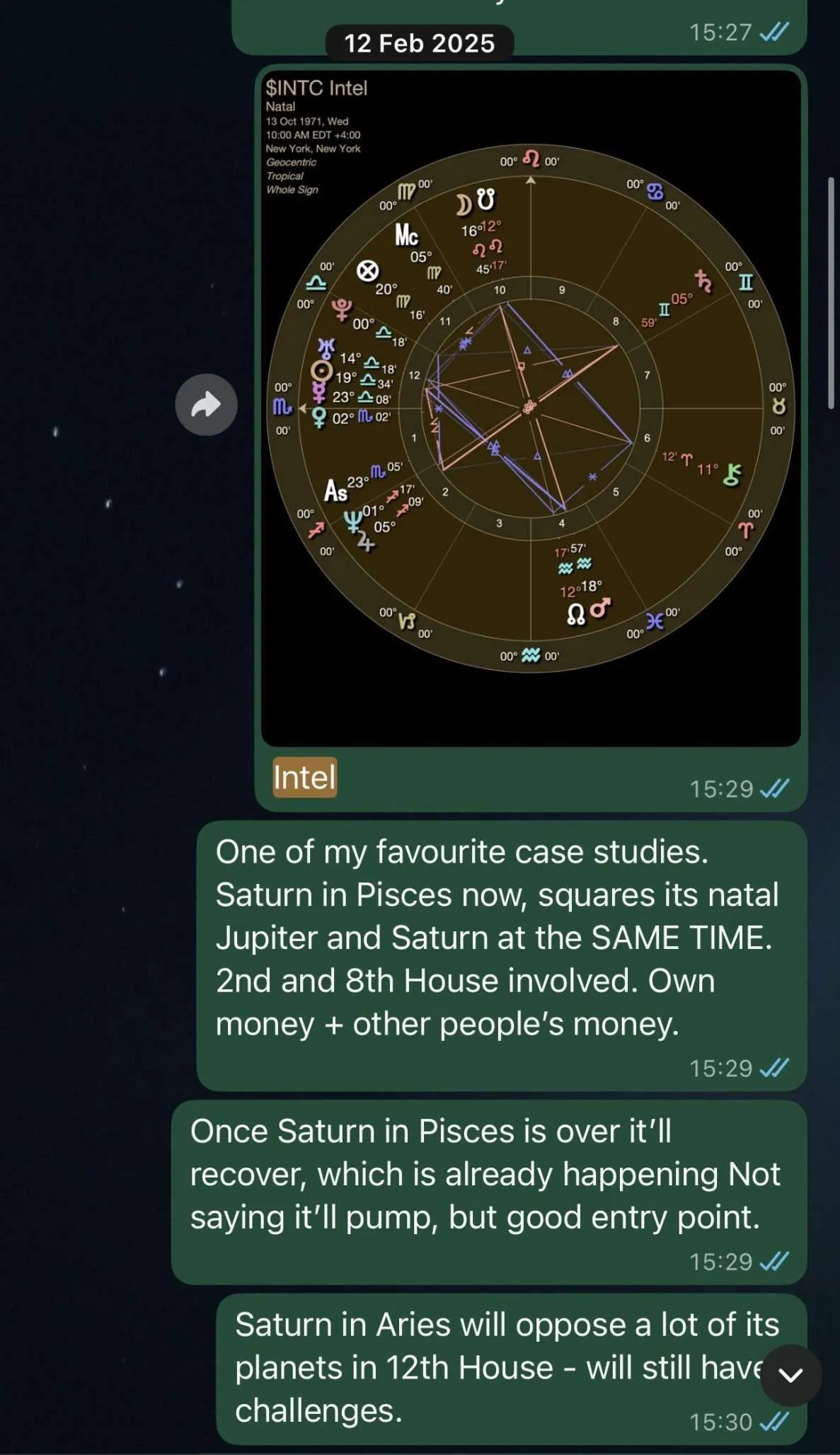


Lip-Bu Tan was announced as Intel’s CEO on March 12, 2025.
There’s actually a lot going on behind the scenes outside of what you see on my Instagram or website. I do have groups of friends whom I’m working closely with and we’re supporting each other to achieve our goals, both monetary and non-monetary.
Back in February 2025, Intel’s stock price plunged as low as $17.67 in April 2025. Would you buy? Most people wouldn’t have, and would have been chasing bigger names like Nvidia and AMD.
Was Intel’s $17.67 Low Written In Its Charts?
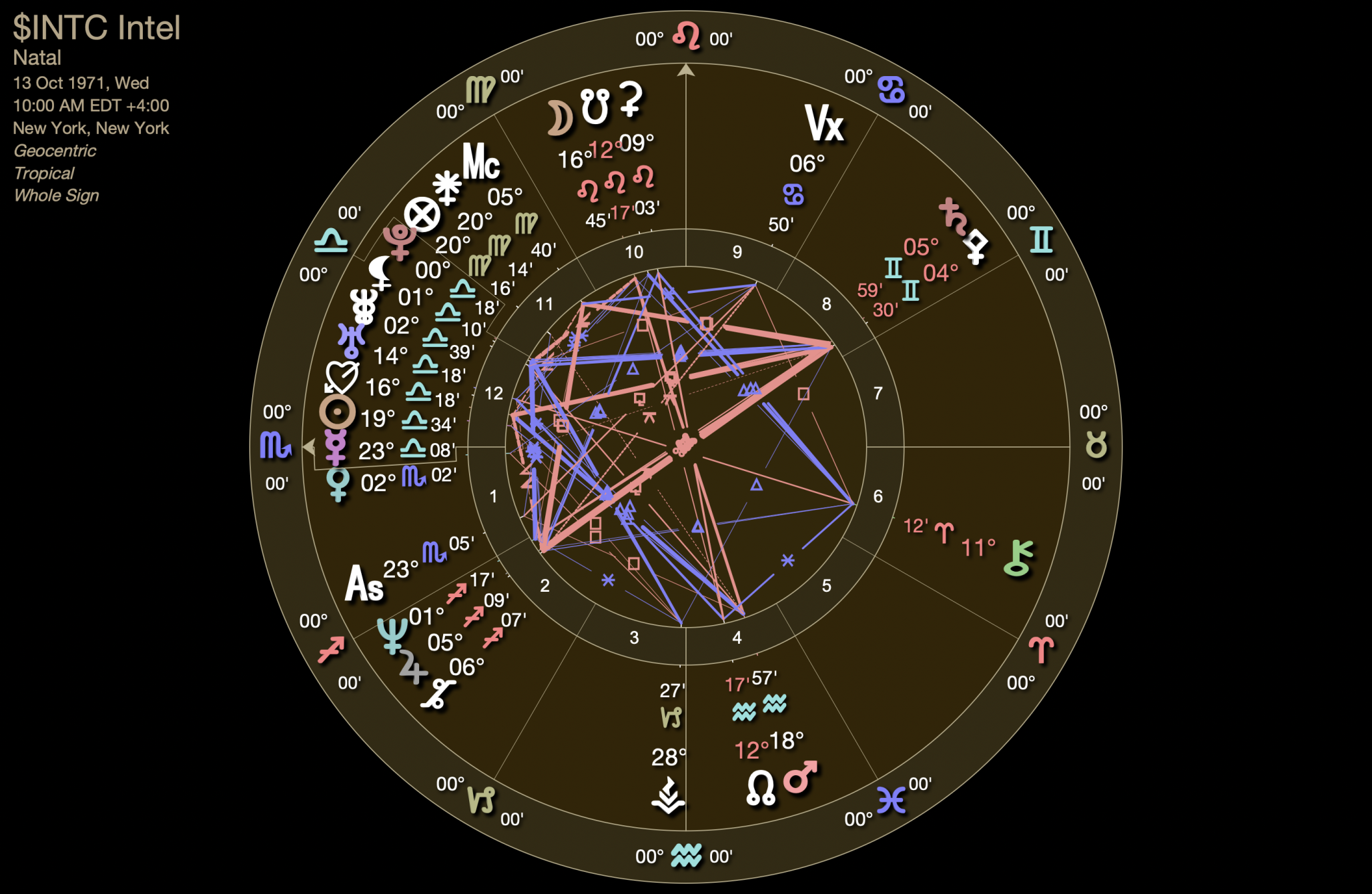
Like all the techniques I’ve picked up through self-study, I was, of course, skeptical. Can astrology really be applied to companies, especially listed companies?
It would be foolish to assume a “yes” without first having tested the hypothesis. Trust me, I’ve tested the hypothesis time and again, and what’s usually require is – patience.
But I’ve reach the conclusion that, yes, companies do have their own birth charts. It’s as though they are a living entity with a life of their own.
Intel hit a low due to Saturn being in its 5th House of Pisces. Saturn was applying pressure to parts of the chart that governs its finances, company direction, and foundations. If you can read charts, you will know the pressure from this Saturn transit was immense.
Intel Has Since Quintupled From The $17.67 Low
INTC closed yesterday at $95.78. That’s a roughly 5.4x return, about 442%, from the April 2025 bottom in 13 months. The 52-week range now sits between $18.97 and $100.53.
For a name most retail investors had written off in favour of Nvidia and AMD, that’s not a small move. Intel’s Q1 2026 numbers came in well above guidance – $13.6 billion in revenue, a 7% year-on-year rise, and EPS of $0.29 against analyst estimates of -$0.01. The pivot toward foundry services under new CEO Lip-Bu Tan is beginning to show up in the financials.
Astrologically, the turning point aligned with Saturn’s ingress from Pisces into Aries on 24 May 2025. That single transit shifted the pressure from Intel’s 5th house, speculative direction, R&D bets, creative leadership, into its 6th house, which governs daily operations, workforce, and restructuring. The alignment matched what was actually happening on the ground: a CEO change, a foundry pivot, and an operational reset. Saturn in the 6th doesn’t crush a company. It rebuilds it.
The entire point of a case study is that it has to age. A forecast that can’t be verified isn’t a forecast, it’s a vibe. Intel’s chart said the pressure would lift when Saturn moved on. Saturn moved on. The price followed.
For full disclosure: I do not hold a license under the Monetary Authority of Singapore or any equivalent regulatory body, and nothing in this post constitutes a recommendation to buy, sell, or hold INTC. This is a documented case study, not financial advice.
Knowing Where To Look In The Charts
Every House and its planetary ruler in the chart tells us something about the company. It can give us insights about its leader, culture, nature of its work, and state of its finances and overall worth.
If you know where to look, you will know how this company will fare in the medium to long run. Structural and environmental challenges always hits a company the hardest, and Saturn will always come to mind first.
Saturn has since left Pisces – and look what happened.
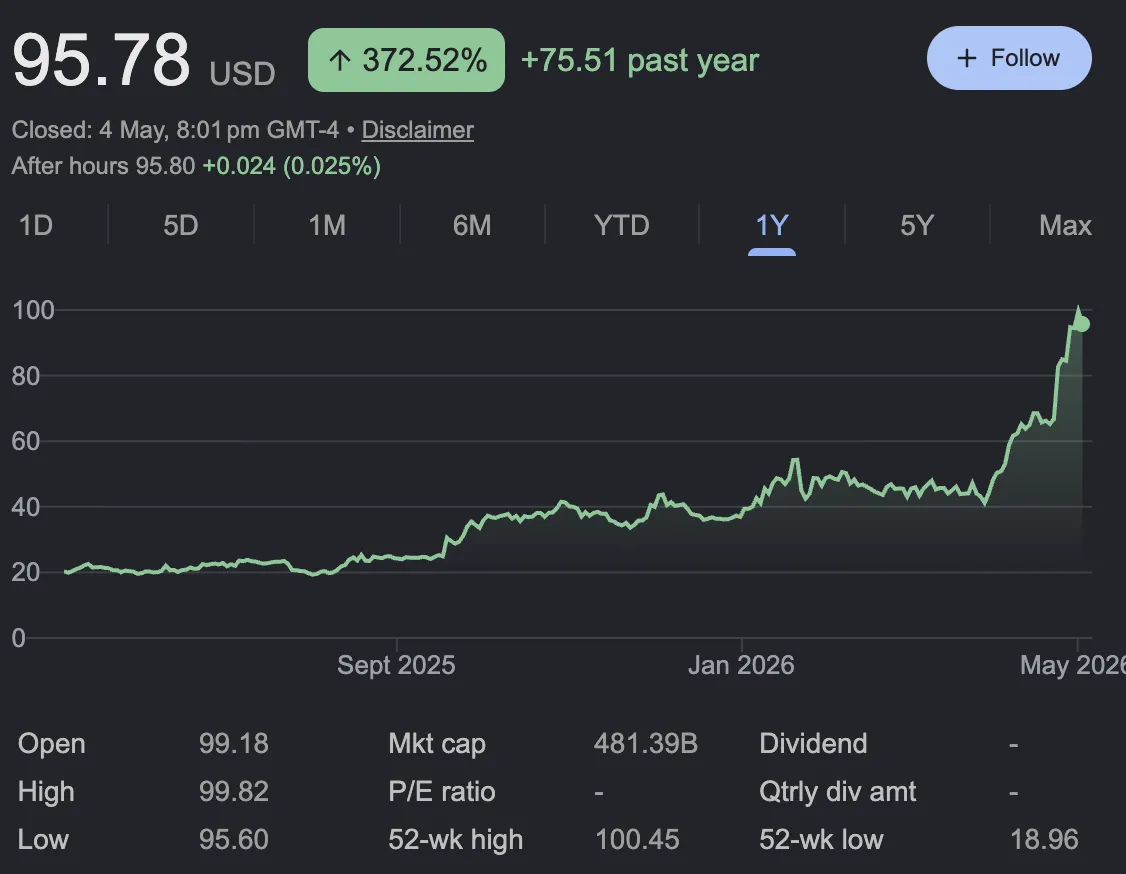
There’s more going on than just Saturn leaving Pisces, but the headline result is straightforward enough.
I will keep this blog post short, and the point of this post is to show and reassure everyone that, indeed, everything has a birth chart.
As tough as it is to believe me, that is the case whether you like it or not.
Pivoting My Practice To Focus More On Business & Finance
I’m sure my close followers will know what’s going on in my personal life outside of work, and those who know me well enough will know what I prioritise and what’s important to me – which I will not repeat here.
I will still operate the same and be giving BaZi consultations and Feng Shui audits and Feng Shui house-hunts. I’ve raised my prices to manage the volume so that I have enough time with my family.
This isn’t exactly a pivot, but more of a shift in focus. I will be positioning myself as a business advisor of sorts. What does this mean?
Here are a few value propositions:
If You Are A Business Owner Or Wish To Be One
This means that if you believe in astrology and you wish to be a business owner, I will effectively be able to pick a date for your company’s incorporation to make sure it has a good chart and a good start. It is akin to picking a c-section date for your baby.
If You Wish To Invest In Companies
If you are considering investing in something, I will effectively be able to give you a different angle of things.
If You Are An Angel Investor Or Fund
Unless you wish to be like Temasek, which has a history of investing in Cat. 4 muppets who drive the company into the ground, my knowledge basically assures you that your money and investments are safe. How do I do this?
The founder of the company you are investing in tells me everything I need to know about what will happen to your money. The incorporation and the day the company IPOs also effectively tells me what will happen to the company.
I’ve done more than enough case studies to assure you that astrology can not just save you millions, but also earn you millions.
For Those Interested In Learning Astrology
My academy has been up and running for a while more, and I’ve recently launched more courses. For the full list of courses, you can refer to it here: Academy of Chinese Metaphysics & Astrology
For financial astrology specifically, you can refer to this page: Financial Astrology Masterclass. I am launching it with $400 off for the founding batch of students. Use the code [FOUNDING] to get started. Expires end of May’26.
For whoever who is fated to stumble upon this page, if you ever need my services, feel free to reach out.
Now, the next big question is: When will the market finally crash? For those interesting in learning, I’ll see you in class.
– Sean
Frequently Asked Questions About Financial Astrology
What is financial astrology?
Financial astrology is the application of astrological principles to financial markets, companies, and economic cycles. It’s a specialised branch of mundane astrology — the astrology of nations, events, and collective movements rather than individuals. Just as a person’s natal chart maps their life trajectory, a company’s incorporation or IPO date produces a birth chart that responds to planetary transits, particularly to its 2nd house (assets), 8th house (debt and shared resources), and 10th house (corporate identity and direction). The discipline traces back to W.D. Gann, whose planetary timing techniques on Wall Street in the early 1900s remain foundational.
Does financial astrology actually work?
I’ll be honest: most people asking this question want a yes-or-no, and there isn’t one. Astrology gives you cycles and pressure points, not next-week price targets. What it requires is patience, and a clean dataset — a verified incorporation date, an IPO timestamp, a founder’s accurate natal chart. Garbage in, garbage out. I’ve tested the hypothesis across enough case studies — Intel, Grab, and others I’ve covered privately with clients — to be comfortable saying it identifies turning points with a usefulness that traditional analysis alone doesn’t replicate. It’s a complement to fundamental and technical analysis, not a substitute.
Who invented financial astrology?
No single person invented it, but the modern Western tradition is most associated with W.D. Gann, an American trader who used planetary cycles, geometric angles, and natal market charts to forecast commodity and stock prices in the early 1900s. His Gann Square and “Master Time Factor” remain studied in trading circles today. Other foundational figures include Louise McWhirter, who developed the McWhirter Method for stock charts, and Donald Bradley, whose Bradley Siderograph modelled market sentiment from planetary geometry. The roots reach much further back into mundane astrology in Babylonian, Hellenistic, and Indian traditions.
How do you read a company’s birth chart?
You start with a clean birth time. For listed companies, the most reliable timestamp is the first trade on the stock exchange — Intel’s, for example, is its 1971 NASDAQ debut, not its 1968 incorporation. From there you cast a chart using tropical Western astrology and read the 2nd house (assets, cash flow), 8th house (debt, M&A activity), 10th house (public-facing identity, leadership), and the chart ruler. Then you overlay current transits — Saturn pressure to financial houses tends to mark contraction; Jupiter ingress to the 2nd often coincides with revaluation. The founder’s chart matters too, sometimes more than the company’s. I cover the full methodology in my Financial Astrology Masterclass.
What’s the difference between financial astrology and Western astrology?
Financial astrology uses the same toolkit as Western astrology — natal charts, transits, progressions, planetary aspects — but applies it to corporate entities and markets instead of individuals. The houses get reinterpreted: a person’s 7th house is their marriage partner; a company’s 7th house is its competitors and contracts. The 4th house for an individual is their family; for a listed company, it’s their headquarters, real estate, and balance sheet foundations. The technical framework is identical. The interpretive lens shifts entirely. A practitioner trained in Hellenistic Western astrology can move into financial work, but the symbolism has to be re-translated.
Is financial astrology the same as financial advice?
No, and I want to be clear about this. Financial astrology is an analytical lens, not regulated financial advice. I do not hold a license under the Monetary Authority of Singapore or any equivalent regulatory body, and nothing in my case studies, blog posts, or consultations should be interpreted as a recommendation to buy, sell, or hold a security. What I provide is a layer of analysis — the same way a fundamental analyst reads a balance sheet or a technical analyst reads a chart pattern. Decisions on capital allocation are yours, ideally made in consultation with a licensed financial advisor.