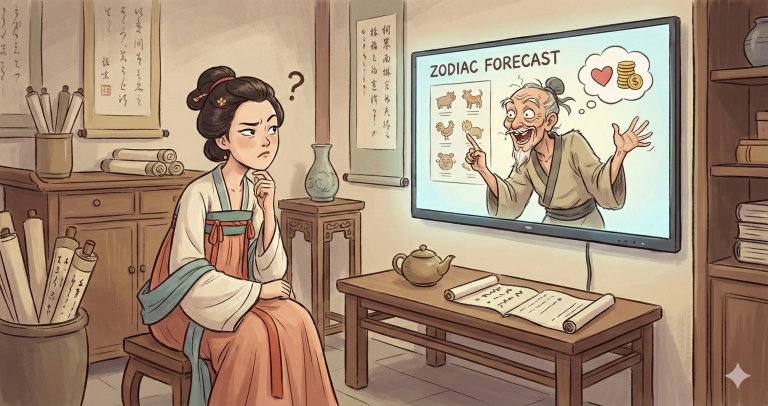
Interpreting a BaZi chart was never meant to be easy. The mere eight characters in the chart often give the false impression that BaZi is something anyone can just pick up, but that’s far from the case. A BaZi chart summarises the cosmos well, but interpreting it accurately requires years, if not decades, of studying case studies, intellectual finesse, and an understanding of how BaZi was developed.
New to BaZi? Generate your chart first with our free BaZi calculator (八字排盤), then follow this guide to read it.
What is a BaZi Chart? A BaZi chart (Four Pillars of Destiny) is an ancient Chinese metaphysical tool used to map an individual’s life path based on their birth date and hour. To read a BaZi chart accurately, one must identify the Daymaster (self-element), assess the Season of birth for strength, and calculate Real Solar Time to ensure mathematical accuracy. Unlike superficial zodiac forecasts, authentic BaZi focuses on the balance of the Five Elements and the 10-Year Luck Pillars to determine life quality and timing.
If you land on any BaZi website, I’m pretty sure you are looking for resources that teach you how to perform a basic analysis of a BaZi chart. This post is for you, and I hope it lays the right foundation for approaching chart analysis, even as a beginner. If you’re interested in learning BaZi, you’re welcome to visit my online school here, where you can pick up the basics:

I wanted to write this post on how to read a BaZi chart because it dawned upon me that, despite being a blog on BaZi and Chinese metaphysics in general, I’ve not written anything on what is probably the most Googled thing about Chinese metaphysics, which is how exactly you read a BaZi chart.
I wish to reiterate that interpreting a BaZi chart is difficult. If you found your way here hoping a blog post would teach you how to interpret your chart accurately and save you money from engaging a practitioner, I’m afraid you’ll be disappointed. However, I’ll still encourage you to read on, because this post is important if you’re considering getting your chart read at some point. Please stay, and I’m sure you’ll enjoy the read!
This will be a rather long post, but if you’ve ever wondered what goes through my mind when I look at a chart, this post will explain the process. If you’re not interested in anything philosophical and would like to get a BaZi consultation, feel free to get in touch. Otherwise, for self-learners, there is always my online school. Whatever it is, I encourage you to finish going through what I have to share with you because it will answer some of the questions that brought you here in the first place.
Many practitioners focus on the technical aspects of a BaZi chart rather than its philosophy. Getting the technicals right is difficult, and few practitioners can do it correctly in the first place. Perhaps what’s causing this lack of proficiency is the appreciation of the philosophical aspect of this ancient art, which I advocate.
Looking at BaZi from a philosophical angle helps humanise this art and makes it a lot easier for people to appreciate it, not just as a mere tool but also as an ancient wisdom that could guide you. Learning something is naturally easier when you appreciate it, and getting good at it is an eventuality. This post won’t teach you how to decipher a chart fully, but I highly encourage you to finish reading it as it’ll add a new dimension to your learning and understanding of Chinese metaphysics.
What Is BaZi and Why Does It Work?
Quick Reference: Core BaZi Concepts
- Daymaster (日元): The focal point of the chart representing “You.”
- Four Pillars (四柱): The Year, Month, Day, and Hour columns representing different life aspects.
- Real Solar Time: The astronomical time used for accurate charting, differing from standard clock time.
- Useful God (用神): The critical balancing element that determines the chart’s quality.
Let’s get the obvious out of the way first.
Popularly known as the Four Pillars of Destiny, ‘BaZi’ means Eight Characters found in the Four Pillars, where each Pillar has a Heavenly Stem and Earthly Branch.
Most people are introduced to BaZi as a fortune-telling tool, which isn’t wrong. BaZi can ‘tell your fortune’ by forecasting one’s life, and it’s extremely easy for a seasoned practitioner to assess one’s calibre and chances of success. I hesitate to call myself a fortune-teller because it feels like a superficial term for something that is the amalgamation of our ancestors’ wisdom, which stretches back thousands of years.
BaZi, and any other method of ‘fortune-telling’, is only possible if one can measure time because reckoning, or being able to perceive time, is required before we can observe patterns and cycles. Whenever you look at a BaZi chart, you look at an ancient calendar. The knowledge behind how this ancient calendar was developed enabled Chinese sages to forecast an individual’s life. BaZi is based on the solar calendar, with its 24 solar terms, and the sexagenary cycle, a time-keeping system unique to China. It consists of 10 Heavenly Stems and 12 Earthly Branches, both of which are independent systems of timekeeping, but were eventually combined to produce a refined, more holistic and reliable form.
Measuring time is often taken for granted because we are born into a world where clocks and time zones already exist. Still, one must remember that there was a time when human civilisation had no concept of how long a year, month, week, or even day felt. The concept of measuring time was only possible because of the cycle observable in the sky and the cosmos. A year was measured by the circling of the Big Dipper; a month was measured by the moon cycle; the earth’s rotation measured a day.
Studying BaZi is no different from studying nature’s laws and how they unfold; their patterns repeat. This belief enabled Chinese sages to develop methods for forecasting one’s life, and you will find the same in other forms of astrology from different civilisations. Ptolemy’s work in astronomy gave rise to the Western astrology we know today, and the work of Hindu sages enabled the development of Vedic astrology.
Understanding The Cosmic Trinity & Its Role In BaZi
The Cosmic Trinity is known as 三才 (sān cái) in Chinese, which refers to Heaven, Earth and Human. The Chinese sages believed that whatever is observable in Heaven will have a physical manifestation on Earth. In other words, human life will parallel nature’s laws.

When you read the Chinese classics on BaZi, you’ll always see that BaZi charts are interpreted idiomatically as though they were like writing a poem. This is simply Chinese thought and Confucianism at work because the ancient Chinese believed we were subject to Heaven’s will and that our lives were inherently and intricately tied to nature’s laws. Whether you still subscribe to this worldview is entirely up to you, I still do.
The nuances of Chinese thought and culture are why you’ll often hear someone’s chart described in terms of what we can see in nature. For example, charts born during arid summer will need Water to adjust to their environment; Yang Metal requires Fire to forge it; or Yin Wood needs the right amount of water, soil and sun to grow. Studying someone’s BaZi chart is akin to seeing his or her life unfold according to parallel laws, hence the saying “As Above, So Below”, or 「在天成象,在地成形」。Someone with an unforged under Yang Metal chart will likely never be successful, and someone under Yin Wood with much Fire will never be able to grow. Unfortunately, some people take the 5 Elements too literally and view them as the tangible things we can see and touch in real life, when the 5 Elements are simply a way of describing how Yin and Yang unfold.
Your natal chart is what you are born with and your foundation. It is a static state. Your “Luck Pillars” or Elemental phases are how things unfold. Returning to the above examples, your natal chart may already indicate that your Yang Metal chart is in a forged state; the remaining step is to ensure this forged state is maintained. Suppose Yang Metal were to remain an unrefined ore, usually represented by an excessively strong Yang Metal Daymaster. In that case, we will then need the chart holder’s Elemental Phases to provide the required elements needed for forging.
Everything in nature has a state and an unfolding process, which is another way of describing the life-and-death cycle that all phenomena go through. Our charts show us where we are in this cycle, which is why our lives are so vastly different, with the high-quality charts thriving and the low-quality charts withering.
This is why people with good charts are always growing, whereas those with bad charts will end up in a destructive spiral. These are all manifestations of nature’s laws.
How Do You Interpret a BaZi Chart Traditionally?
I know you probably Googled “How to read a BaZi chart”, hoping to get some basics on interpreting it. Let’s get that out of the way first and touch on some fundamental theory. Most people start off reading a BaZi chart by understanding a few basic concepts, such as:
Step-by-Step: How to Read a Bazi Chart
- Identify the Daymaster: Determine which of the 10 Heavenly Stems represents the self.
- Assess the Season: Check the Month Branch to see if the Daymaster is strong or weak born in that season.
- Check the Roots: Does the Daymaster have support (roots) in the Earthly Branches?
- Find the Useful God: Identify the element needed to balance the chart’s temperature or strength.
The Foundation Of A BaZi Chart & Why It’s Called “Four Pillars Of Destiny”
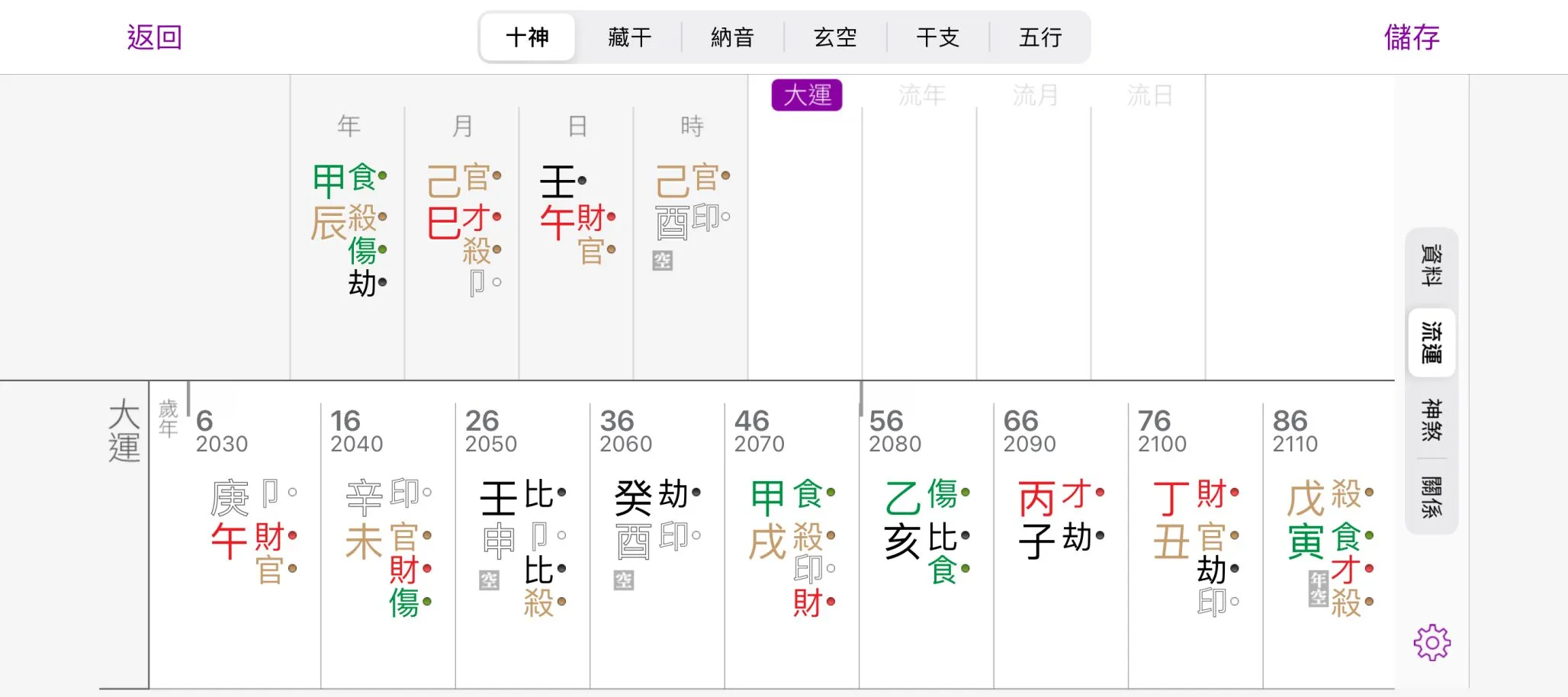
A BaZi chart comprises Four Pillars: the Year Pillar, Month Pillar, Day Pillar, and Hour Pillar. Each Pillar is, of course, a nominal marker of how time is measured. A BaZi chart is also made up of the Ten Heavenly Stems (十天干) and Twelve Earth Branches (十二地支), which are further broken down into 5 Elements and their Yin-Yang polarities.
Every position, element, or shall we just say significator, in a BaZi chart tells us something about a person’s life. For example:
The Year Pillar
This Pillar represents our roots, parents, thoughts, and perspectives. A positive Year Pillar is akin to having a strong, supportive foundation in life.
The Month Pillar
This Pillar represents our siblings, peers, and plays an important role in the unfolding of events when assessing someone’s transits or 运。
The Day Pillar
This Pillar represents us and the “self” because it is where the Daymaster (日元) resides. The Day Branch (日支) also represents our marriage, home, and how we express ourselves.
The Hour Pillar
This Pillar represents children and descendants, and the latter part of our life.
As easy as the above steps and interpretation of a BaZi chart sounds, please always remember that any form of astrology is not that straightforward. Behind each symbol, element, and significator in the chart lies a few thousand years of history and knowledge that make BaZi analysis possible.
It’s safe to assume that it’s always difficult for any layman to understand what the chart is trying to communicate, whether from a technical or philosophical perspective. To most people, charts are seen as “This year is good; this year is bad” or “This 10-year Luck Pillar” is good; this 10-year “Luck Pillar” is bad”. There’s nothing wrong with this per se, and as long as the chart is broken down very logically by theory, you’ll be able to understand the key milestones you need to look out for. It may be a turning point or a downturn to watch for. I think what I wish to point out here is this: The typical way people react to a BaZi reading is that, during the good years, they expect their desires to be met, and during the bad years, they live in unnecessary fear and worry. It’s a very superficial and linear way of looking at things, and it’s not the best use of metaphysics.
When most people start learning how to interpret a BaZi chart, it is always about identifying the Daymaster, the 5 Elements, and how these 5 Elements express themselves in the chart as Heavenly Stems and Earthly Branches. Then, it would be about identifying what each Element or ‘god’ represents in one’s life. For example, when assessing marriage, students are taught to identify the Spouse Element and then mouth off the interactions with the Spouse Element.
Many newly minted practitioners conducting BaZi courses will say that the key to understanding the Bazi Chart is to analyse how the 5 Elements interact in detail, when there is much more to it.
I always tell my clients to see every year and the 10-Year Phase as interconnected. If you see them as independent and separate, you’ll miss out on many valuable insights into your life, how it will unfold and how you are developing. Isn’t that where we are today, but a build-up of everything we’ve been through and all our decisions thus far? The Chinese classics don’t address the notion that your Annual Phases and 10-Year Phases are interconnected. I reckon it’s because they assumed people would read the charts this way and understand the philosophy it was built on, which modern-day audiences don’t pay attention to.
The notion of seeing every 10-year phase and annual phase as interconnected started to develop as the number of charts under my belt grew and as clients kindly shared their personal stories with me. You begin to notice patterns and how things are not what they seem on the surface. Perhaps one of my biggest observations is that desires being met aren’t always a good thing. It may look good now and on the surface, but I’m sure many of us have made decisions we eventually regret. This is where the interconnection between phases comes in.
When conducting a BaZi analysis, I’ve always mentioned that looking at the 10-year phases (大运) is most important because this is your current macro-environment. It plays a highly critical role in how your life unfolds. If your 10-year phase is negative, there is no point in having a positive annual phase, which is why I always say that annual zodiac forecasts are pure nonsense because they don’t take this simple yet fundamentally important step into account. There is a proper, structured way of analysing a BaZi chart. Ignoring the 10-year phase and just looking at the annual phase is a complete deviation and misapplication of the theory, and no legitimate practitioner should be doing this.
Why Solar Time vs. Clock Time Matters in BaZi Calculations
I will take credit for getting the industry to realise that using the time on the clock is incorrect. It was only when I started making a big hoo-ha online that many incumbents suddenly realised that Solar Time was a thing because no one was interested in its astronomy.
If you think about it, clocks and GMT time zones did not exist back when BaZi was first developed.
BaZi involves the 24 Solar Terms, which means the Sun is involved. BaZi is a system based on the Earth position relative to the Sun, which is why we use Solar Time.
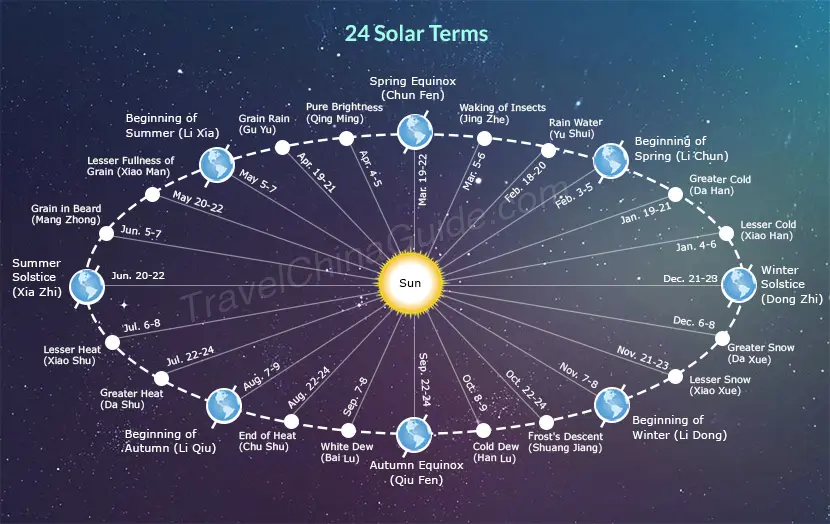
Nny BaZi reading done without Solar Time adjustment is mathematically incorrect, and any BaZi practitioner who doesn’t know something as simple as this isn’t qualified to do their job because they didn’t bother studying the theoretical foundation of the art.
Why It Matters: Even if it’s a rounded estimate from your practice, use numbers. Example: “In my analysis of over 8,500 cases, failing to adjust for Real Solar Time resulted in a Pillar shift in approximately 15% of charts, leading to entirely different ‘Useful God’ identifications.”
Why You Must Use Real Solar Time (Not Clock Time)
Real Solar Time, also known as Apparent Solar Time, is measured by the Sun’s actual position in the sky. It is based on the Sun’s apparent motion across the sky due to Earth’s rotation.
Let’s understand Solar Time a bit more:
- Apparent Solar Noon: The moment the Sun is at its highest point in the sky, when it crosses the local meridian. At this time, Apparent Solar Time is exactly 12:00 noon.
- Solar Day Variability: The length of a solar day (the time between successive solar noons) varies throughout the year due to the elliptical shape of the Earth’s orbit and the tilt of its axis. This variation causes Real Solar Time to differ slightly from the mean or average time kept by clocks, which is known as Mean Solar Time.
In ancient times, before modern timekeeping, Apparent Solar Time was the standard for daily activities. Sundials are instruments that measure Real Solar Time by casting a shadow that moves as the Sun changes its position in the sky.
The geography of where you were born matters, and the degree of Solar Time adjustment varies depending on your longitude. Why? Because the Earth’s rotation causes the Sun to appear at different positions in the sky at different longitudes. This results in natural variation in solar time based on your location.
How Modern Media & Pseudo Practitioners Bastardised BaZi
| Feature | Authentic BaZi Analysis | Conventional/Commercial BaZi |
| Time Standard | Real Solar Time (Longitude-adjusted) | Clock Time (GMT/Standard) |
| Primary Focus | Luck Pillars (10-Year Phases) | Annual Zodiac Forecasts |
| Methodology | Five Element Balance & Philosophy | Generic Animal Sign Luck |
| Outcome | Holistic Life Strategy | “Fortune Telling” / Superstition |
| Complexity | High (Requires years of study) | Low (Simplified for mass consumption) |
The masses have misconstrued the right way of interpreting a BaZi chart, no thanks to the ridiculous culture of annual zodiac forecasts, and what was meant to be a good year could end up going to waste if the chart is interpreted wrongly. BaZi was never intended to be used this way. We have so many annual forecasts only because the general public has no idea what’s going on, yet people still demand them. Everyone will have good and bad phases, you can’t escape this natural law. The top-notch charts are those that, despite a bad phase, sustain minimal harm because they are well-structured. That’s why we always say a balanced chart is a good one, except in special cases.
I always ask people to see every 10-year or annual phase as interconnected. Your future phases will be positive because your current one is negative, and vice versa. Sounds weird? Read on, and I’ll explain.
Nothing valuable in nature comes about without going through some forging process, and even the beautiful things in nature will eventually break down and decay. The bad phases we go through are precisely a reflection of nature’s way of moulding you. On the flip side, the good phases aren’t last forever either, and there will come a point where things start breaking down and decaying. This cycle is just how reality is. Plotting someone’s 10-year phases has a formula to it, and the Stem and Branches that appear aren’t random; the formula is basically a description of nature’s laws. I’m not sure about other practitioners, but whenever I look at a chart, it’s as though I’m seeing a product of nature and see the events that it has to go through and whether or not it comes out stronger and more beautiful, or it whether it withers away. You will always hear that good charts are “balanced” because many of the good things we see in nature are also balanced.
When Earth and Water are balanced, they form a lake, which can nourish life. If either one overpowers the other, nothing forms. Too much Earth and Water get sucked dry; too much Water and Earth get completely washed away. The same logic applies to other elements, like Wood and Fire, Wood and Metal, and so on. These aren’t concepts I developed, they are written in the Chinese classics.
If I may quote 徐大升’s《元理赋》, it goes 「金旺得火,方成器皿;火旺得水,方成相济;水旺得土,方成池沼;土旺得木,方能梳通;木旺得金,方成栋梁。」 The entire verse describes how two equal forces come together to form something valuable. The “balanced way, or 中庸之道, is central to Chinese thought, and it is precisely what the Yin and Yang symbol represent.
The next question everyone should ask themselves is whether pseudo-practitioners and the media, along with their Annual Zodiac Forecasts, are doing Chinese thought and culture justice.
Understanding The Hidden Meaning & Philosophy Behind A BaZi Chart
Your natal chart determines your foundation, but what’s important is how you develop from that foundation. Yes, some natal charts are better than others, but that’s something out of our control, so there’s no point debating about it, and there’s nothing a practitioner can do to change that, contrary to what most people believe. Metaphysics is not a shortcut to your life’s problems. Yes, you can get insight from it, but the change must come from the chart-holder, not the practitioner. I always help clients focus on the phases they go through because it shows how the chart-holder will grow and develop from the foundation on which they were born. I believe I mentioned this before: I can see whether someone who is going through a tough time will crumble or rise from the ashes using their 10-Year Phases; I can also see whether someone who is having a good time is starting to get complacent.
I want people to see every phase as interconnected because what you go through in the past will have some form of impact in the present and future. I’m not trying to get people stuck in the past; rather, if you fail to see how things are interlinked, you may find yourself at the mercy of fate without realising it. This is something I experienced before.
I think I may be confusing some people, so perhaps let’s use a chart as an example:
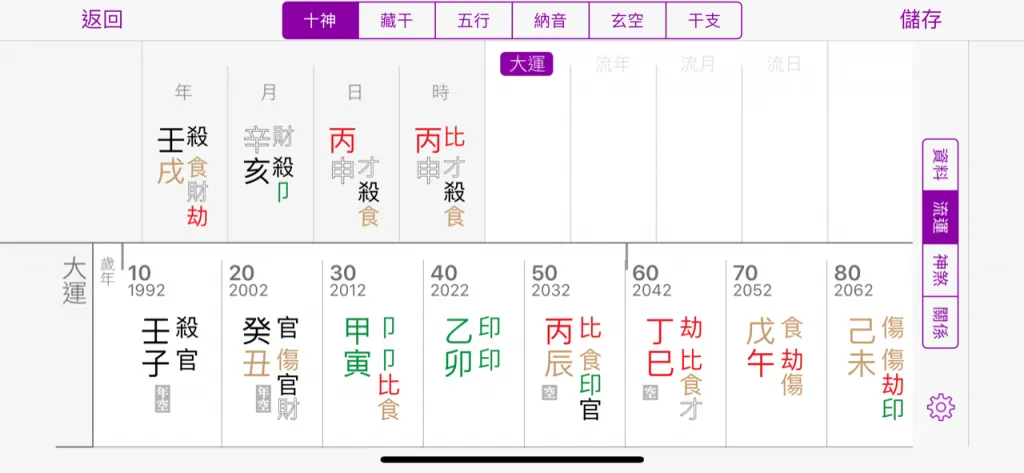
I’ll briefly summarise the key points:
- This chart indicates that the Yang Fire (丙火) Daymaster needs strengthening, so the first two 10-year phases are definitely considered challenging, as Water does not achieve that.
- The chart-holder eventually moves into a much better phase by his third 10-year phase, which is his Wood phase, this is the period where his Fire Daymaster starts to strengthen.
The key focus is the transition into his positive Wood phase, which occurred in 2012. A transition into a new 10-year phase always brings about significant change, and almost all my clients fail to appreciate how impactful such a shift can be. A move into a positive phase is definitely worth celebrating; a move into a bad one should not be underestimated. How one’s life turns out depends on the 10-year phases, and I cannot emphasise enough how important it is to encounter positive ones.
Your 10-year “Luck Pillars” or Elemental Phases hold much more weight than the annual Phases you go through. The 10-Year “Luck Pillars” reflects the changing seasons in your BaZi chart, and there is a deeper meaning behind them than people realise.
When someone is about to enter a new 10-year phase, signs of the shift to a different macro-environment will begin to appear a few years before the transition year. Using the example above, the chart-holder would notice changes from 2010 to 2011, and by 2012, he realises that his whole life has changed and finds himself in a very good place. Certain events enabled him to progress well in life. It helps that 2010 and 2011 were positive years as this transition happened. The transition into a new 10-Year Phase will vary depending on your annual phases, so everyone’s experience will differ.
Let’s address how each phase is interlinked. It gets a bit philosophical here. As mentioned above, the way the chart and the 10-year phases are plotted has a formula, and we all know that the Stems and Branches progress in a fixed order according to a formula, the sexagenary cycle. What I’m trying to get people to see is the meaning behind this ‘order’ and formula for plotting charts. The chart-holder above cannot move into a Wood phase without first going through a Water phase, yes, his natal chart is a bit more challenging, but that’s not the point here. The point here is that he has (a lot of emphasis on “has”) to go through a difficult phase first before the good ones can come. It’s simply nature’s law, just like the changing seasons and the endless cycle of birth and death.
All living things go through the same cycle; our charts tell us which part of the cycle we are at, which decides our chart quality and life trajectory. You can either be ina cycle where growth and development are ahead of you or in a cycle where death and decay are setting in.
Imagine a person who is always growing and improving, with one achievement after another, then imagine another person who is spiralling downwards uncontrollably. That is your cycle of life and death manifested through human life.
Returning to the above example, I’ve spoken with the chart-holder extensively to understand what he went through, and it’s notable that he experienced a significant mindset shift as he moved into his Wood phase. The difficulties he went through during his first two 10-year phases were a required process, or phase, for him to have a ‘revelation’ before he moved into his positive phase, that’s how life works, and with this, naturally, his career and other aspects of his life started to go smoothly. I can relate to the impact such a transition in one’s chart can bring, as I’ve been through one myself. The bottom line is never to underestimate the impact of your 10-year Elemental Phases, it’s even more important than your natal chart.
I’ve often argued that there’s no such thing as luck because what we go through is nothing but what we put out there into our environment. Our 10-year “Luck Pillars” reflects our mindset and how we develop in relation to our environment. I’ve repeatedly mentioned that the word “luck” is not a good translation of the Chinese character 运, which we often use in metaphysics. “Luck” is when things happen out of nowhere, and this is the exact opposite of what metaphysics is about, which is cause-and-effect. There is no such thing as “happening out of nowhere” in metaphysics.
Some people might say that, but some things are out of our control, like the workplace or circumstances we are in, that’s true. However, I am still inclined to say that the decisions we make, including how we respond and the meaning we derive from our experiences, have brought us to where we are today. Those in good environments or companies deserve to get there because they focus on developing themselves and have the right mindset. They are like the trees that survived winter and are given a chance to bloom again during spring, this is the cycle of nature’s law, and BaZi is precisely a description of these laws.
The same law that governs the universe can also explain why some people have benefactors and others don’t. It’s not my first time writing about why some people seem to have many benefactors, and most don’t.

Our mindset determines who we keep around us and who we attract into our lives. If we were to find a parallel in nature, two species with a symbiotic relationship would thrive together. Even within a single species, those who display signs of helping each other and altruism eventually survive and thrive. I took a module on evolution under the University Scholars Programme, so trust me when I say animal species do what even humans don’t do. You will need something to give before someone offers it in return. For example, vampire bats share blood and have social preferences. Bats who refuse to share will eventually be ostracised by the colony and left to perish should they be unable to find food for themselves.
People born under these auspicious stars have benefactors because of how they are, they are well-liked, respectful, or even altruistic, and this attracts people to them. It’s not because they are ‘lucky’. The laws of nature are simply cause-and-effect.
Remember that your 10-year phases reflect your mindset and the environment, they are interlinked, and you cannot separate them. This is Yin and Yang at play, as they must interact before reality takes shape. Yes, it is a chicken-and-egg situation: it’s hard to maintain a positive mindset in a tough environment, but such debate is paralysing and unproductive. We all know that our mindsets can change, and if it does, our environments can be changed too. Nothing in metaphysics is assessed independently as an end in itself, and it is incorrect to see BaZi as a tool for predicting arbitrary events.
Low-Quality BaZi Charts: The Unfortunate Case Of People Who Will Never Grow
You might be asking, what if the person never encounters a positive phase? There are definitely such cases:
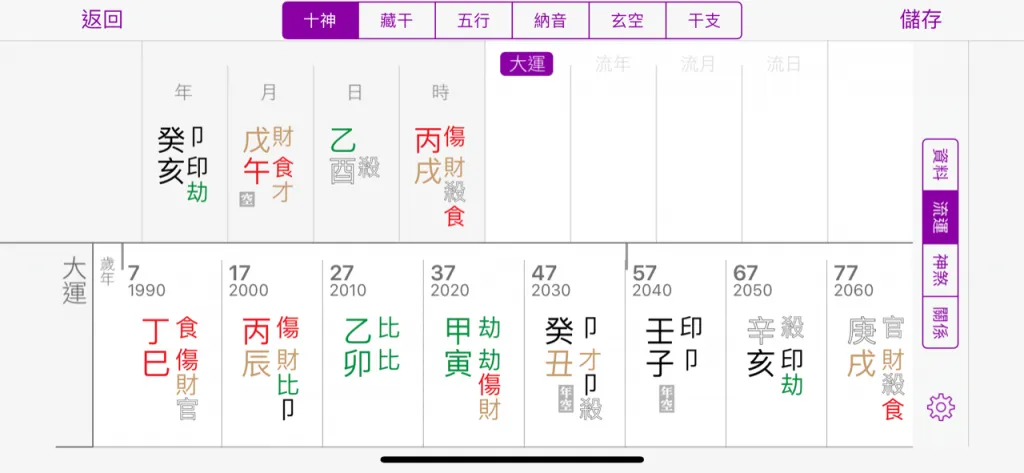
Let’s admit it. Bad people exist, and this, of course, can be seen in someone’s chart. Someone’s natal chart can be bad, and they might be born with some character flaws, but the biggest pity is not a poor natal chart but that the person doesn’t change or grow from it.
The above chart-holder will consistently encounter six (yes, six) negative 10-year phases since the start of his life. By the time he enters a positive one, he will be 57. I know everyone probably can’t tell from the chart. Still, the above chart-holder has a significant character flaw, and, sadly, he fails to see how his mindset is sabotaging him. The six consecutive negative 10-year phases tell a practitioner one thing: he won’t realise where he’s going wrong, and his mindset won’t change. Life will hit him so hard that his best years will already be gone when he realises it. He can only start laying a foundation for his life and enjoy it in his 50s. This is one of those charts where the chart-holder sinks even deeper instead of learning from his past mistakes.
The interconnection between the past and present phases is that the chart-holder simply refuses to acknowledge what’s going wrong. Hence, each 10-year phase becomes progressively worse than the previous one. The worst 10-year phase would be his 2020 甲寅 phase, and he will hit rock bottom in 2025 and 2026 before realising he needs to change, but even that will take time.
Remember that this person’s background is not as challenging as some people I’ve met. I’ve seen people with even more challenging backgrounds handle life with much more grace, and, unsurprisingly, they are doing much better because they are likeable. People naturally help them, their mindsets are so healthy that they adapt, grow and become great, inspiring people.
To put it another way, if you are going through troubled times and you realise no one is helping you, please make it a point to ask yourself why.
What May Seem Good On The Surface May End Up Harming You
Many of my clients come to me right after they have moved into a new 10-year phase or just when they are about to. It’s not surprising because one encounters the most change when a 10-year phase transition is near. This can happen internally, within yourself, or externally, such as in your physical or work environment. People typically seek clarity during such periods.
I often get asked whether it’s a good time to make career changes, and this is a good example to showcase how one’s 10-Year “Luck Pillars” and Annual Phases are interlinked. When someone’s about to enter into a negative 10-year phase, we can naturally assume that he or she will face career challenges, and the pending career move will not be a positive one. Still, the confusing part comes when what’s presented to the chart-holder is positive. There can be several reasons for this, and I’ve personally come across such cases in my consultations:
- The career move is made because another company offers higher pay, but why is it not a good move then? In metaphysics, we don’t assess good or bad by using money. Yes, someone can get offered 2x more salary, but for 10x more work, would you think it’s a good move?
- At times, such moves also affect the career trajectory of the chart-holder. A career change can throw someone’s career off course. Eventually, the chart-holder realises that the opportunity cost is much higher than expected, especially when outcomes are poor.
- Many things are out of your control, and if you’re not careful, you may end up in an environment that isn’t good for you and find yourself stuck there, all because of something that appears positive on the surface when it is not.
I think the best way to explain this interconnection between the different phases is that you take something from it and move on to the next phase as you go through the various life stages and events. There will also be instances where life pushes you towards a new environment. Some people view challenges and setbacks as opportunities to become stronger, whereas others continue to spiral downward due to a toxic mindset. Many of us don’t realise how a seemingly small decision can change our lives forever.If there’s one thing I learned from Chinese metaphysics, it’s to never look at things superficially. I always remind my clients to calm down before making a decision because what may seem positive initially may be detrimental in the long run.
For the people who eventually encounter a positive phase: If you’ve had three consecutive negative 10-Year Phases, don’t expect your life to turn around instantly when you enter a good phase suddenly. The process and its unfolding will take time, as with any natural phenomenon. The timing and manifestations will vary from chart to chart, depending on factors such as your natal chartis structure and whether the year of transition is favourable for you.
It Helps To Understand The Story Behind A BaZi Chart
Your BaZi chart is a story of your life. This post aims to help readers appreciate how each 10-year phase and year are interconnected, and how the BaZi chart tells the story of our lives, their vicissitudes, and how we grow and adapt from them.
Never see BaZi merely as a tool to help you determine when your desires will be met. It might help you get there, but it is certainly not a magical tool to make things happen without you putting in the due effort. There is a much deeper meaning to the Pillars and Chinese characters you see in your BaZi chart, and understanding these meanings gives you a better life.
If you can see the story behind what the BaZi chart tells you, it’ll help you make better decisions. What your chart says about you and your life is much more than what the media or commercialised pseudo-practitioners portray. You are missing out on a great deal by not studying the history and philosophy of this field. Your natal chart, 10-year phases, and annual phases come together to form a story of how your life unfolds, it’s a story of how you, as a person, with your mindset (be it positive or negative), interact with your environment and how you grow from there. The transition into different phases provides key insights into whether the transition is positive or negative, what drives it, and its eventual impact or meaning.
Key Takeaways
- Interpreting a BaZi chart is complex and requires years of study; it’s not as simple as it seems.
- BaZi, or the Four Pillars of Destiny, involves understanding the Heavenly Stems and Earthly Branches and reflects cosmic laws.
- The Cosmic Trinity connects Heaven, Earth, and Human life, illustrating nature’s impact on individual destinies.
- Understanding your 10-Year Luck Pillars is crucial; they reveal life cycles and developmental phases.
- Be cautious with surface-level interpretations in BaZi; meaningful insight requires deeper philosophical engagement.
Make your decisions carefully, and be very aware and honest with yourself if you are truly developing, because this ultimately separates a good chart from a bad one. Charging forward recklessly to pursue your goals and dreams isn’t always the best approach. Going through a rough patch is not bad either, it’s simply a process required before something of metaphorical beauty forms, you have to understand this.
– Sean