I've been getting a lot of requests for my input on how a Qi Men Dun Jia chart should be broken down and deciphered. I briefly wrote about it a long time ago via this post introducing Qi Men Dun Jia, but it was nothing too technical or in-depth. I was too distracted by the fact that I was having fun with it, rather than giving a proper introduction to Qi Men Dun Jia. I decided to write a technical post focusing on the technical aspect of things.
This post does not aim to teach you everything you need to know about deciphering a chart, but it lays down some of the basics, hopefully setting some standards in the field and standing out from all the other primers you can find elsewhere on the internet.
More importantly, this post is to bring everyone back onto the ground and remind everyone that Qi Men Dun Jia is not something you can easily pick up in a few weeks or months unless you're telling me you're proficient in BaZi or you know the concepts of Yin Yang, 5 Elements, and the Stems and Branches like the back of your hand. There are a lot of courses out there right now given by practitioners who appeared out of nowhere, and to be honest, I'm concerned and appalled at the same time.
If you're considering picking up actual techniques to use for yourself, you can consider signing up for my Qi Men Dun Jia Beginner Workshop here:
Alas, let's not digress. This post is a quick overview of how to read a Qi Men Dun Jia chart, and I hope you find it helpful.
The Basics Of How To Read A Qi Men Dun Jia Chart
Without going into the technicalities, the steps behind interpreting a Qi Men Dun Jia chart are:
Step 1: Formulate a Specific Question (The setup is key).
A Qi Men Dun Jia chart is a cosmic response to a human query. The clarity of the chart depends entirely on the clarity of the question.
Step 2: Identify the Yong Shen (Useful God).
The Yong Shen (Use God/Useful God) is the focal point of the chart—the specific symbol that represents the "Subject" of your question. If you look at the wrong symbol, you get the wrong answer. For example, if you are asking about a wealth question, you would typically look at 戊 (Yang Earth) or 生门 (Life Gate).
Step 3: Analyse the Interaction between the Yong Shen and the Day Stem.
Once you have the Yong Shen, you must compare it to the "Self."
- The Day Stem (Day Pillar): Represents You (the asker/querent).
- The Hour Stem (Hour Pillar): Represents the Matter/Outcome (the situation).
Step 4: Evaluate the Strength of the Elements (旺相休囚死).
Just because the Palaces support each other doesn't mean the result is good. You must look inside the Palace to see the quality of the components.
Step 5: Check for Special Formations (Void, Punishment).
This is where the amateur is separated from the master. A chart can look perfect on the surface, but hidden technical factors can nullify the entire reading.
The Four Realms of a Qi Men Dun Jia Chart
For a start, just understand that a Qi Men Dun Jia chart is made up of four main layers:
- Earth Plate (地盘): The foundation, represented by the 12 Earthly Branches and 8 Trigrams.
- Man Plate (人盘): The 8 Gates (Doors) representing human actions and relationships.
- Heaven Plate (天盘): The 9 Stars representing timing and environmental factors.
- God Plate (神盘): The 8 Deities representing the unseen spiritual influence or "luck."
Like any other Chinese astrological technique, most people get overwhelmed when they first see a Qi Men Dun Jia chart and immediately ask, "Where do I start?"
First and foremost, you need to understand what makes up a Qi Men Dun Jia chart and the building blocks that form one. You'd always be looking at a 2D image when a chart is generated, but try to imagine several charts stacked on top of each other, but confined within the 9 Sectors represented by the 8 Trigrams and a central sector (中宫)。 The image below describes this very aptly:
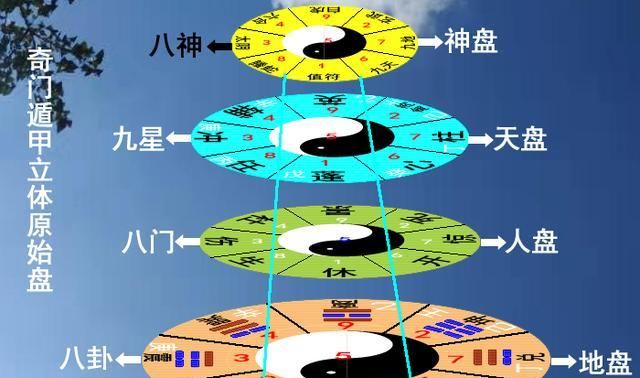
A Qi Men Dun Chart consists of the following parts:
- 神盘 or 'Gods' chart: This is part of the chart where you find the 8 'gods' (八神) we use in Qi Men Dun Jia. Qi Men Dun Jia has a saying called 神助 in Qi Men Dun Jia, and it refers to the influence of these 8 'gods' it has in the chart.
- 天盘 or 'Heavens' chart: This is where you find your 9 stars (九星), which are the same stars we use in feng shui and Zi Wei Dou Shu. These are the stars you find in the Big Dipper.
- 人盘 or 'Gates' chart: Some practitioners call this chart Doors, but I prefer the word Gates. There are 8 in total, and the Gates represent humans and human dynamics.
- 地盘 or 'Earth' chart: This is represented by your 8 Trigrams (八卦). Within the 8 Trigrams are also your 12 Earthly Branches (十二地支), which will come in useful when analysing a Qi Men Dun Jia chart.
- 格局 or Sector Structure: Each sector in the Qi Men Dun Jia chart has a structure formed by the Heavens and Earth charts. You will see two Heavenly Stems (十天干) in every sector, with one resting on top of another. All Heavenly Stems are used except Yang Wood (甲木) and can be paired in any way, but note that if the Stems in the Heavens Chart and Earth chart are flipped, it's considered a different structure. For example, 辛 sitting on 乙 has a different meaning from 乙 sitting on 辛。
- 盘外格局 or External Structure: This is just referring to the BaZi chart or Four Pillars that were used to generate the Qi Men Dun Jia chart. BaZi, or Four Pillars, is a forecasting technique on its own, but please do not forget that it's still a time-keeping system at its core, which is why you'll always see it in other Chinese astrology techniques. We can use the BaZi chart that reflects the time on the Qi Men chart to derive useful information.
Now, imagine the different parts of the charts stacked on top of each other, and this is what you get:
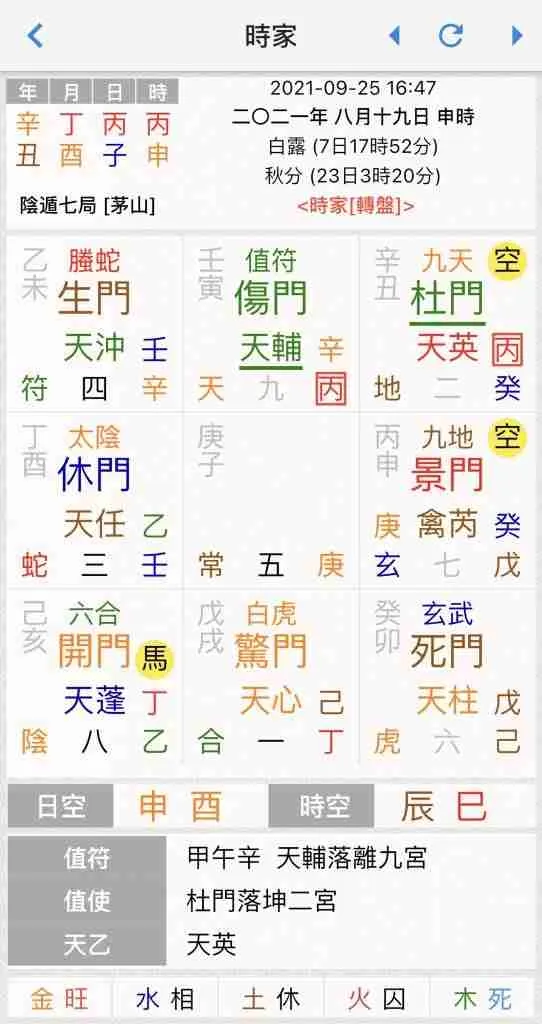
What you're looking at is supposed to be 3D but is rendered in 2D, which is fine. If you understand its building blocks, there's no need for a 3D chart to do what it's supposed to do.
How Is Qi Men Dun Jia Used?
Newcomers to Qi Men Dun Jia don't know what this technique does because its application is very different from BaZi and Zi Wei Dou Shu.
As confounding as it sounds, Qi Men Dun Jia is no different from going to a temple to cast a divination lot (求签) or getting a tarot card reading. If you have a question in your mind, ask it, and the universe gives you a response. Qi Men Dun Jia is the Chinese version of divination, with tarot cards and horary astrology of Western astrology as some of its counterparts. Note that Qi Men Dun Jia is not the only Chinese divination method available - there are also 六壬 and 太乙。
One core concept in Qi Men Dun Jia is 万物相干论, which refers to the interconnection of everything. In modern science, we give it a different name, such as the Theory of Everything or Superstring Theory. The Chinese sages explored the same concept but could only articulate it in terms relevant to their era. I've always found it perplexing that sceptics dismiss Chinese metaphysics so easily, yet do not do the same for modern physics.
The Qi Men Dun Jia chart is a snapshot in time, and what most people forget is that we and our lives are also part of this snapshot of time while sharing an interconnection with everything else, which is why whenever you generate a Qi Men Dun Jia chart with a sincere question in mind, it tends to really speak to you provided you know how to interpret the charts.
Divination techniques require a great deal of focus, with the heart and mind in the right place. If you're casting a divination or asking a question that you have no intention of acting on, then it's not meant to happen, and the chart will not speak to you.
In the past, I used to go to the temple to cast a divination lot because that was the only divination method available to laypeople, but Qi Men Dun Jia can be done anywhere.
Different Types Of Qi Men Dun Jia
When I say different "types" of Qi Men Dun Jia, it's not referring to a different technique of interpretation. It refers to a different method of plotting the chart. There are different types:
- 刻家奇门
- 时家奇门
- 月家奇门
- 年家奇门
- 金涵奇门
The core difference among the methods is the number of permutations possible, and the timeframe used to interpret the charts differs accordingly. That's why you'll see 年,月,日,时, which refers to Year, Month, Day, and Hour.
People usually use 时家奇门 because it has the most permutations: 4320. Still, each chart will repeat itself four times, so there are 1080 unique charts in the Hour-Version of Qi Men Dun Jia (时家奇门)。金涵奇门 is unique due to its history, and it is the version of Qi Men Dun Jia used by Zhang Liang (张良) and Zhu Ge Lian (诸葛亮)。
There are a few other technical aspects that are important to understand, such as plotting the Qi Men Dun Jia chart, although most hobbyists and even new 'practitioners' would not bother with it. Any form of divination or astrological technique requires precise calculations of the planets and where Earth is, and it's no different for Qi Men Dun Jia.
You would hear terms like 置润,拆补, and 茅山 that some newly minted practitioners would label "different techniques" of Qi Men Dun Jia, but they are not. These terms are used to account for intrinsic marginal errors when plotting a Qi Men Dun Jia chart. Qi Men Dun Jia uses the Solar Terms (节气) just like BaZi does, and the Solar Terms change approximately every 15 days. The keyword here is "approximate": the actual time is 15.2184 on average, so there will be some errors in longer time intervals. 置润,拆补, and 茅山 are just terms used by different schools to make adjustments. It does not change how a chart is interpreted, but plotted.
Lastly, let's also not forget that Qi Men Dun Jia also differentiates between Rotating Charts (转盘) and Flying Charts (飞盘). Almost all Qi Men Dun Jia charts are interpreted using Rotating Charts, and Flying Charts aren't used except in special situations. Rotating Charts assess the macro-environment, whereas Flying Charts focus more on human issues and dynamics and less on the environment.
Where To Begin In Interpreting A Qi Men Dun Jia Chart?
You will always hear the term 'Yong Shen' (用神) in Chinese metaphysics. It will mean different things in different Chinese astrological techniques. In BaZi, it refers to the critical element in the chart that must be balanced. In Zi Wei Dou Shu, the Four Transformer stars (四化) are often deemed the 用神, which tells us how the events will unfold.
In Qi Men Dun Jia, 'Yong Shen' refers to the part of the chart where you find your answer, and there can be more than one 'Yong Shen' in this case. Where you find your answer, of course, depends on what kind of question you're asking. For example:
- If someone comes to me for a Qi Men Dun Jia divination regarding relationships, the 'Yong Shen' in this would be Yang Metal (庚), representing the male and Yin Wood (乙), representing the female. Their Year Stems can also be used.
- If it's about money, we look at Yang Earth (戊) and Gate Of Life (生门) as these symbolise these aspects of life.
Everything we experience in the physical world can be symbolised by something you see in the Qi Men Dun Jia chart. One might ask why a mere 5 Elements, 10 Heavenly Stems, and 12 Earthly Branches possibly represent everything in the world. This is where one needs to go back in history and understand Yin Yang and Chinese cosmology, and the notion of 取象。
The common practice when looking for the answer is to look at the Hour Stem when the chart is generated, but it's not always the case. Once we know where to look in the Qi Men Dun Jia chart, we can start going in-depth and find out what will happen because merely knowing where the symbols representing your answer lie is not enough.
What Can Qi Men Dun Jia Predict And What Is It Used For?
Many people shy away from Qi Men Dun Jia because they don't understand how it can be applied. To keep things simple, we can say Qi Men Dun Jia can be applied to "everything" because its principles and laws are based on 万物相干论 where everything is interconnected. Of course, you don't apply it to trivial matters like what you should eat for dinner, although it's still possible.
The point is that the more significant and important the event, the more substantial and salient the manifestation it has on Earth. The chart will speak to you more if it is important to you, which is why casting a divination was considered sacred and not something to be trivialised.
Some of the common uses of Qi Men Dun Jia and what it can be used for are:
| Domain | Yong Shen (Focus Point) |
| Wealth / Business | Life Gate (生门) + Wu Earth (戊) |
| Relationships | Yi Wood (乙) & Geng Metal (庚) |
| Health | Grain Gate (Rui) + Heavenly Star |
| Career | Open Gate (开门) |
| Feng Shui | Life Gate (生门) |
The 'Yong Shen' (用神) and what you need to look out for will be different for every event. You will need to know where to look in the chart, then analyse the combined meanings of the Gods, Gates, Sectors, and Stars.
The 'Story' Behind The Qi Men Dun Jia Chart
I will not attempt to explain how a Qi Men Dun Jia is interpreted because this is a complex technique misconstrued as something anyone can do.I can understand why people might feel that this is an easy technique to pick up, but the lack of fundamental knowledge in Chinese metaphysics leads to many wrong interpretations. I'll use this segment to discuss what the Qi Men Dun Jia chart is trying to convey.
The Qi Men Dun Jia chart is like a snapshot in time; to be fair, any astrological chart you read is a snapshot in time. The point is to know what this snapshot in time tells you and what will happen on Earth based on the information you get from it.
Every part of the chart comes together to paint a story of the current situation and how it will unfold. The 'Gods', Stars, Gates, and Heavenly Stem structure are all symbols of something; different symbols coming together will mean different things. The position of these symbols also alters their meaning, and even seasons also alter the meaning. You can even bring BaZi techniques into Qi Men Dun Jia if you want to.
What you see might be a static 2D image of the chart, but when you should be seeing is how different parts of the chart interact with each other and the flow within the chart.
As you can tell, interpreting a Qi Men Dun Jia chart might look simple on the surface, but it is not and there is a lot of depth to it.
Advanced Theories Of Qi Men Dun Jia
I am very insulated from what is being taught in the commercial world, but from what I know, it's been dumbed down to sell to the masses. Most people only apply this logic when interpreting a Qi Men Dun Jia chart:
"If the sector representing the answer gives birth to the sector representing me, it's favourable to take action."
If that were the case, there'd be no need to look at anything else but the Earth chart, and we could make our deductions using the 8 Trigrams. Qi Men Dun Jia is essentially about examining eight boxes and determining whether the two relevant ones are in favour of each other.
The requirements needed to be proficient at Qi Men Dun Jia are no different from BaZi. You need to understand the Heavenly Stems, Earthly Branches, and the technicalities of it. As mentioned in the previous section, where the Gods, Gates, and Stems land in the chart will change their meaning. The seasons and Four Pillars generated will also change their meaning.
There are a few advanced theories that you really need to understand before you can even begin interpreting a Qi Men Dun Jia chart, and I would not encourage anyone to try interpreting charts until they fully understand these concepts:
- 击刑 refers to specific positions under which Stems are harmed.
- 空亡, which refers to "Void Emptiness", which you'll often hear in BaZi.
- 入墓 and 入库, which refer to an element or Stem entering its Tomb or Vault position.
- 旺衰, which refers to the strength and state of the Stems
Everything above will alter the state of the Qi Men Dun Jia chart and change its meaning and interpretation. Understanding the nuances of these terms is important for interpreting the chart correctly.
Should You Learn Qi Men Dun Jia?
Well, that's up to you, and I will refrain from commenting further here, as my blog would already have addressed topics like this.
The only thing I wish to say is that not everyone is meant to study this, and most people can't differentiate between being curious about something and truly having an affinity with it, and this applies to everyone - prospective students and prospective practitioners alike.
One more issue I wish to point out is that we're in an era where anyone can appear out of nowhere, declare themselves as a practitioner or master, and start giving BaZi or Qi Men Dun Jia consultations.
Please just be careful with who you approach to get a reading from and, more importantly, who you learn from. If you believe in Chinese metaphysics and how it's still relevant, and you believe in what Qi Men Dun Jia can do and how it can forecast outcomes and describe how phenomena manifest, then it makes sense to believe that many people end up approaching the wrong kind of 'practitioner' simply because it's written in the stars.
- Sean