- Key Takeaways:
- Zi Wei Dou Shu (Purple Star Astrology) is a Chinese astrological system focusing on “Space” (Palaces) rather than just “Time” (BaZi).
- It uses 14 Major Stars (like The Emperor) and 12 Palaces (e.g., Wealth, Spouse) to map destiny.
- It is often considered more detailed than BaZi for pinpointing sources of problems (e.g., who causes the issue).
What is Zi Wei Dou Shu? Zi Wei Dou Shu (紫微斗數) is a Chinese astrology system that maps destiny through “space” rather than time. Where BaZi reads the position of the Earth around the Sun, Zi Wei Dou Shu places fourteen major stars across twelve palaces (命宮 Life, 財帛 Wealth, 夫妻 Spouse, 官祿 Career and so on). Because it isolates the exact palace an issue sits in, it is often more precise than BaZi at pinpointing the source of a problem, including who is causing it.
Before I start, refrain from calling Zi Wei Dou Shu “Purple Star Astrology” because it sounds ridiculous. There is nothing “purple” about this star, even though Zi here means purple in Chinese. ‘Zi Wei’ is another term for the emperor.
I’ve added a webpage for Zi Wei Dou Shu to provide information on this technique. I’m not sure if BaZi or Zi Wei Dou Shu is more popular here in the region, but generally, these would be the two methods you would hear of when looking for an astrological reading.
If you haven’t already known, I’m familiar with both methods and have combined BaZi and Zi Wei Dou Shu in my consultations to provide deeper insights for my clients. Applying two methods simultaneously helps ensure my analysis is on the right track. Despite being two very different methods, the conclusions drawn will not contradict each other. In other words, if one’s BaZi chart indicates a certain weaker area in life, the Zi Wei Dou Shu chart will say the same. If they contradict, one method is clearly flawed, which we know is not true. Both are well-established methods that have stood the test of time.
I will introduce Zi Wei Dou Shu in this post and address some frequently asked questions about the differences between BaZi and Zi Wei Dou Shu. I’ll start writing more on Zi Wei Dou Shu since it’s part of the service I offer, and readers have indicated interest.
If you wish to pick up the basics of Zi Wei Dou Shu, you’re welcome to sign up for my online course here:
What Exactly Is Zi Wei Dou Shu?
Zi Wei Dou Shu is one of the many Chinese astrological forecasting methods and is extremely popular amongst the Chinese. Its origins are a bit more mysterious, as you’ll hear several versions.
The origins of Zi Wei Dou Shu are somewhat convoluted, with differing accounts of who the actual founder was. Some argued that it was the Taoist sage Chen Tuan (陳摶) during the Song Dynasty, whereas others argued that it was Lü Dongbin (吕洞宾) of the Tang Dynasty, many Chinese will know as one of the Eight Immortals (八仙) worshipped by Taoists.
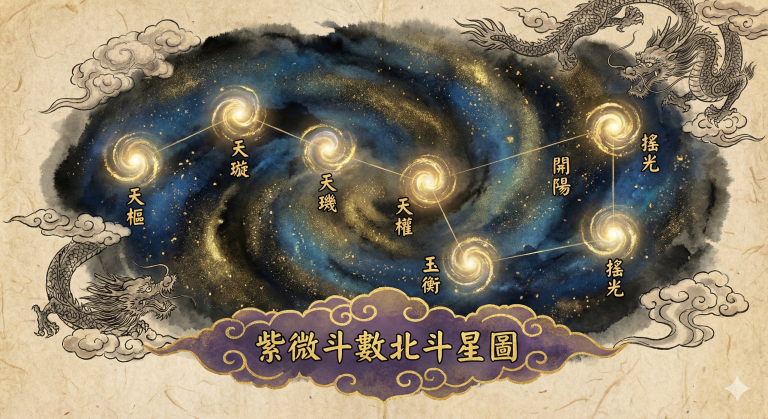
Zi Wei Dou Shu held the title of 五大神数之首, meaning out of the five known methods of astrology, Zi Wei Dou Shu was considered the supreme method. Most of what we know of Zi Wei Dou Shu was initially passed down orally, and not many books were written on it, unlike BaZi. Unlike BaZi, which looks at the position of Earth around the Sun, Zi Wei Dou Shu observes the position of the stars instead, with the significant stars coming from that of the Big Dipper and six from the Sagittarius constellation.
| Feature | BaZi (Eight Characters) | Zi Wei Dou Shu (Purple Star) |
|---|---|---|
| Astronomical Basis | Solar Time (Position of Earth around the Sun). Uses the 24 Solar Terms (节气). | Lunar/Stellar (Position of the Moon & Virtual Stars). Uses the Lunar Calendar. |
| Core Structure | 4 Pillars (Year, Month, Day, Hour). Focus on “Time” flows. | 12 Palaces (Life, Wealth, Spouse, etc.). Focus on “Space” & Sectors. |
| Primary Components | 5 Elements, 10 Heavenly Stems, 12 Earthly Branches, 10 Gods (e.g., Direct Wealth). | 14 Major Stars (Archetypes like ‘The Emperor’), Minor Stars, 4 Transformers (Si Hua). |
| Best Used For | The “Macro” View: Assessing overall chart quality, elemental balance, and potential capacity (e.g., “Am I wealthy?”). | The “Micro” Details: Pinpointing the source of events (e.g., “Who causes the problem? My boss or my partner?”). |
| Predictive Style | Abstract: Analyzing invisible forces (Qi) and elemental temperatures. | Visual/Narrative: Reading a “story” based on how Star Archetypes interact in specific Palaces. |
| Spouse Analysis | Uses the Spouse Element (Single Variable). Focuses on partner’s quality. | Uses the Spouse Palace + Opposite Palace. Focuses on the dynamic/interaction (e.g., “Do we argue?”). |
| Learning Curve | Steep Start: Hard to grasp abstract concepts initially, but fast to read once mastered. | Deceptive Start: Easy to memorize stars, but extremely difficult to master the “Flying” interactions (Si Hua). |
What Makes Zi Wei Dou Shu So Popular?
Zi Wei Dou Shu is arguably more popular because many people find it easier to pick up. Why though? It’s because, as long as you know what each of the main stars represents and look at which sector it ends up, you will be able to tell a few things. This notion excites a lot of newcomers because you can say a thing or two just with this superficial knowledge. However, please remember there is much more to a Zi Wei Dou Shu analysis than merely reading off the charts and where the stars land.
One special trait of Zi Wei Dou Shu is that it can be used to deduce the root cause of a particular event and the areas of your life it will affect. This is primarily determined by the Four Transformers (四化), which represent the impetus and process of change within the chart. Other Chinese astrological methods may be unable to point these things out as clearly.
For example, BaZi and Zi Wei Dou Shu can help a practitioner deduce that someone may be facing career difficulties. However, we’ll need to consult Zi Wei Dou Shu to determine how this might occur. It’s not that BaZi is incapable of doing this; Zi Wei Dou Shu can provide a much more precise and accurate picture. The root cause of career challenges might take different forms, such as a company not doing well, a less-than-ideal superior, or simply not being up to the task. The same goes for marriage: the breakdown and friction within it can stem from various factors. For some, it may be due to character flaws; for others, to financial issues.
This is the reason why I combine both methods during my consultations because I realised that the questions that people are used to asking aren’t answerable using BaZi, and people tend to want to know the details and exactly how and where life’s challenges will come from, which is perfectly normal.
Which Is The ‘Better’ Method?
There’s no right answer to this, and there is no point in addressing this question. These are just different techniques built on similar underlying laws of the universe. Both methods have their merits, and I enjoy using both. In terms of complexity, Zi Wei Dou Shu is definitely more complex, which is why it could go into more detail. The great thing about BaZi is that analysis can be done extremely quickly; an experienced practitioner can determine the quality of a chart in just a few minutes. Both have a lot to bring to the table.
Perhaps let me explain it like this: if your question is “I want to know an overview of my life and if I stand a good chance of success”, BaZi would be sufficient. If your question is more specific and goes, “I want to know exactly how and where the opportunities or challenges will come from”, Zi Wei Dou Shu would be more suitable.
How Do You Read A Zi Wei Dou Shu Chart?
Reading a Zi Wei Dou Shu chart is done palace by palace. You start at the 命宮 (Life Palace), which anchors the whole chart and describes the person’s core self. From there you read how the fourteen major stars, led by 紫微 (the Emperor star), fall across the twelve palaces, since each palace governs one area of life such as wealth, marriage, career or health. You then layer on the 四化 (the four transformations of fortune, authority, status and misfortune) and the 大限 (ten-year luck periods) to see how the chart moves through time. A full reading takes training, but this is the structure every reading follows.
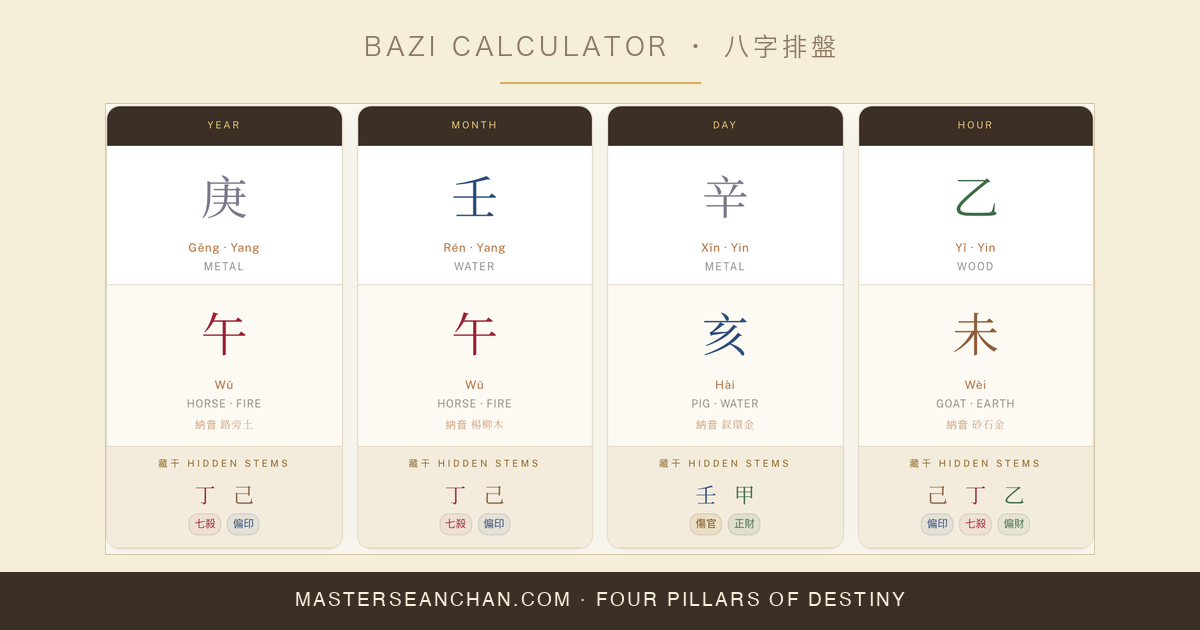
You’ll realise that a BaZi chart and Zi Wei Dou Shu chart look drastically different. You can see it for yourself below:
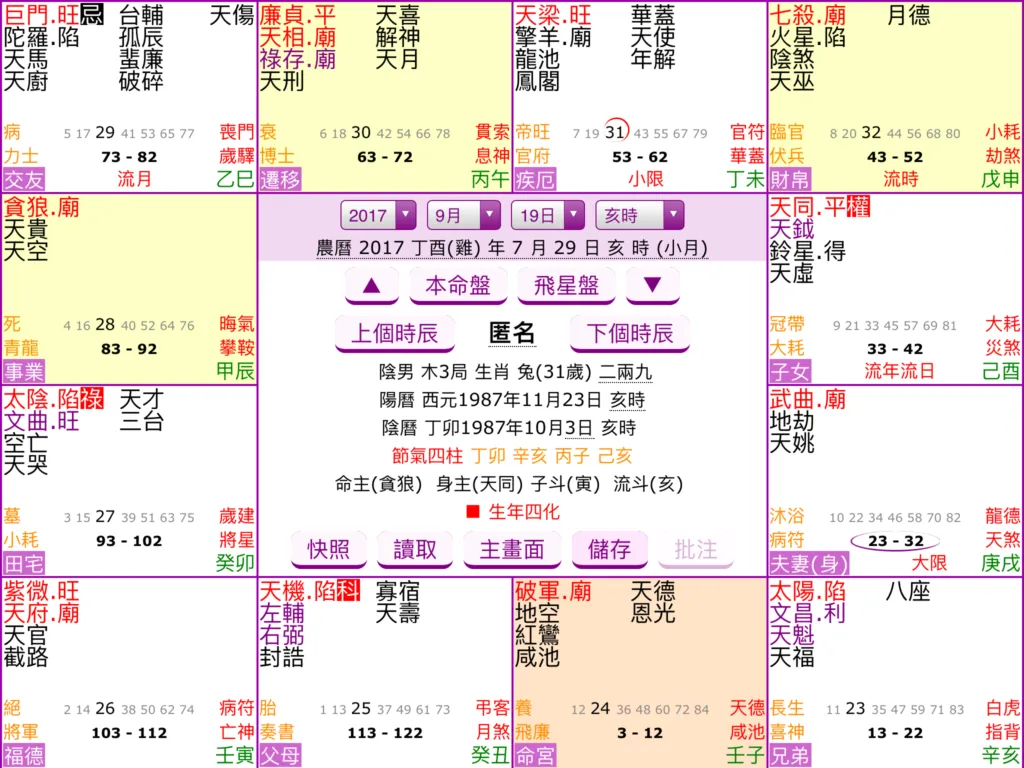
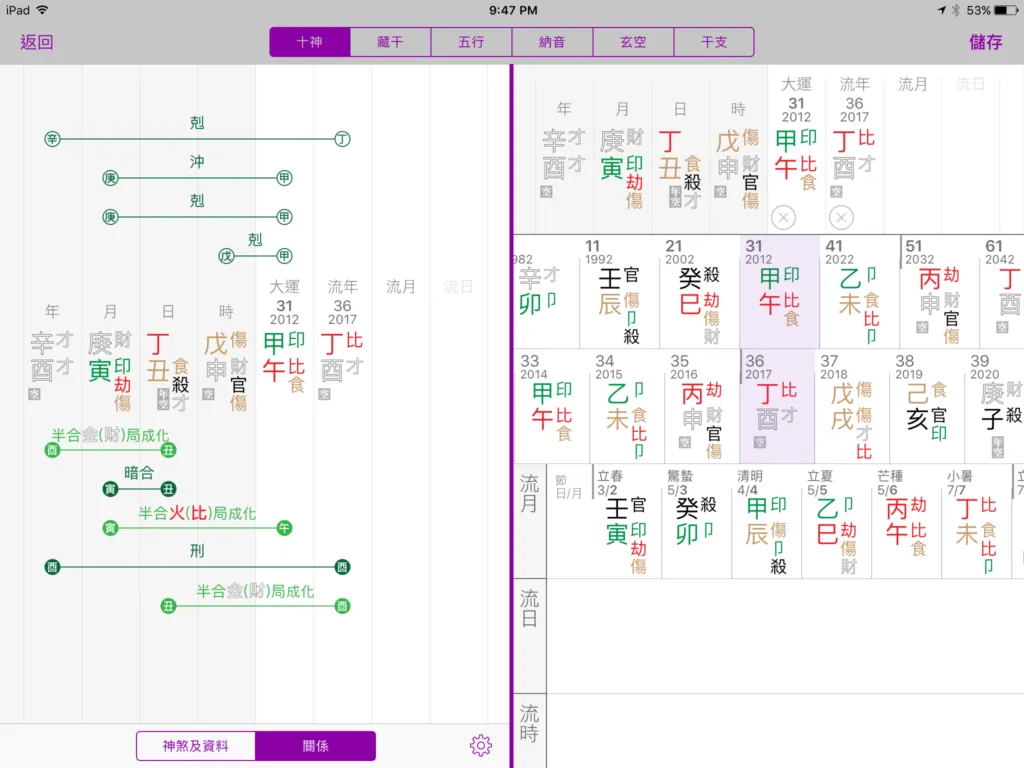
As you can see, a Zi Wei Dou Shu chart is much more complex. The most easily identifiable element in the chart is the 12 Palaces (宫位), which represent different aspects of one’s life, such as family, home environment, career, finances, and more. Zi Wei Dou Shu also has the concept of Annual and 10-Year Phases as well, similar to BaZi, although we usually call it ‘ da xian‘ (大限) instead of ‘da yun‘ (大运) for Zi Wei Dou Shu.
Despite their surface differences, they are ultimately grounded in astronomy, and both are snapshots of the moment someone is born. Parallels between the two methods do exist, although expressed differently. For example, in Zi Wei Dou Shu, the 12 Palaces are your 12 Earthly Branches, but in BaZi, it is not expressed using the 12 Palaces but by the individual Earthly Branch itself.
If you wish to learn how to analyse a Zi Wei Dou Shu chart effectively, you’ll need to be familiar with the following:
- The major stars used in Zi Wei Dou Shu. This determines your chart structure, which is crucial in determining the overall quality of your chart.
- The minor stars include both your beneficial and destructive stars. For a chart to be top-notch, you’ll need beneficial stars to end up in the important sectors.
- You need to be familiar with how to analyse the different 10-Year phases and Annual Phases.
- Most importantly, and perhaps the most complex part. You’ll need to know the influences of the Four Transformer stars.
Zi Wei Dou Shu requires you to think more deeply and in more abstract ways. Although it seems easier to pick up because you can just read off which stars land where, applying it effectively is a different story.
Flying Stars & Multiple Representations
One habit of beginners in this field is to blindly read the chart and identify which star ends in which Palace, without applying the other techniques required for the analysis. There are several other techniques that one must appreciate before any form of meaningful analysis can be done, such as:
- ‘San Fang Si Zheng’ (三方四正): Palace aspects, representing the intricate relationships shared by certain Palaces.
- ‘Da Xian Si Hua’ (大限四化): The 10-Year Phase Transformers
- ‘Ti’ and ‘Yong’ (体,用): The foundation and the unfolding process
- ‘Gong Gan Si Hua’ (宫干四化): The Four Transformers from each Palace
- ‘Gong Wei Zhuan Huan’ (宫位转换): The dynamic representation of each Palace
Let’s take ‘Gong Wei Zhuan Huan’, for example: If you have read my Zi Wei Dou Shu case study on career success, I gave an example of one’s Health Palace (疾厄宫), which is originally supposed to represent one’s health. This sector can also represent how well the company one is working for is doing. The key here is knowing when the Health Sector is supposed to represent what, when do we associate this Palace with health, and when do we associate it with the company one’s working for? This is where the concept of ‘ti’ (体) and ‘yong’ (用) comes in.
All the above-mentioned concepts are what give Zi Wei Dou Shu the ability to go into the details of one’s life, and quite frankly, there is still more to it than whatever I’ve mentioned. You have to see how the 10-Year chart (大限盘) interacts with the natal chart (本命盘) and can go even deeper to see how the Annual Chart (流年盘) interacts with the 10-Year chart.
There are also certain special combinations and patterns of the Flying Stars to consider. For example, you’ll often hear of such terms in advanced Zi Wei Dou Shu applications:
- Lu Chu 禄出
- Ji Chu 忌出
- Fong Gong Ji 反弓忌
- Ni Shui Ji 逆水忌
These are just a few examples, and there are many more to look out for.
Imagine 4 stars flying out of the 12 Palaces, that’s 48 stars flying about, but this is just the tip of the iceberg because you still need to trace how the stars move and the subsequent Palaces they fly into. Now, bring in your natal chart, 10-Year chart and finally your Annual Chart into the picture, that is a total of 144 Flying Stars to take into account, and this is still considered a superficial application because we have yet to take into account the overlapping layers of the charts and Palaces.
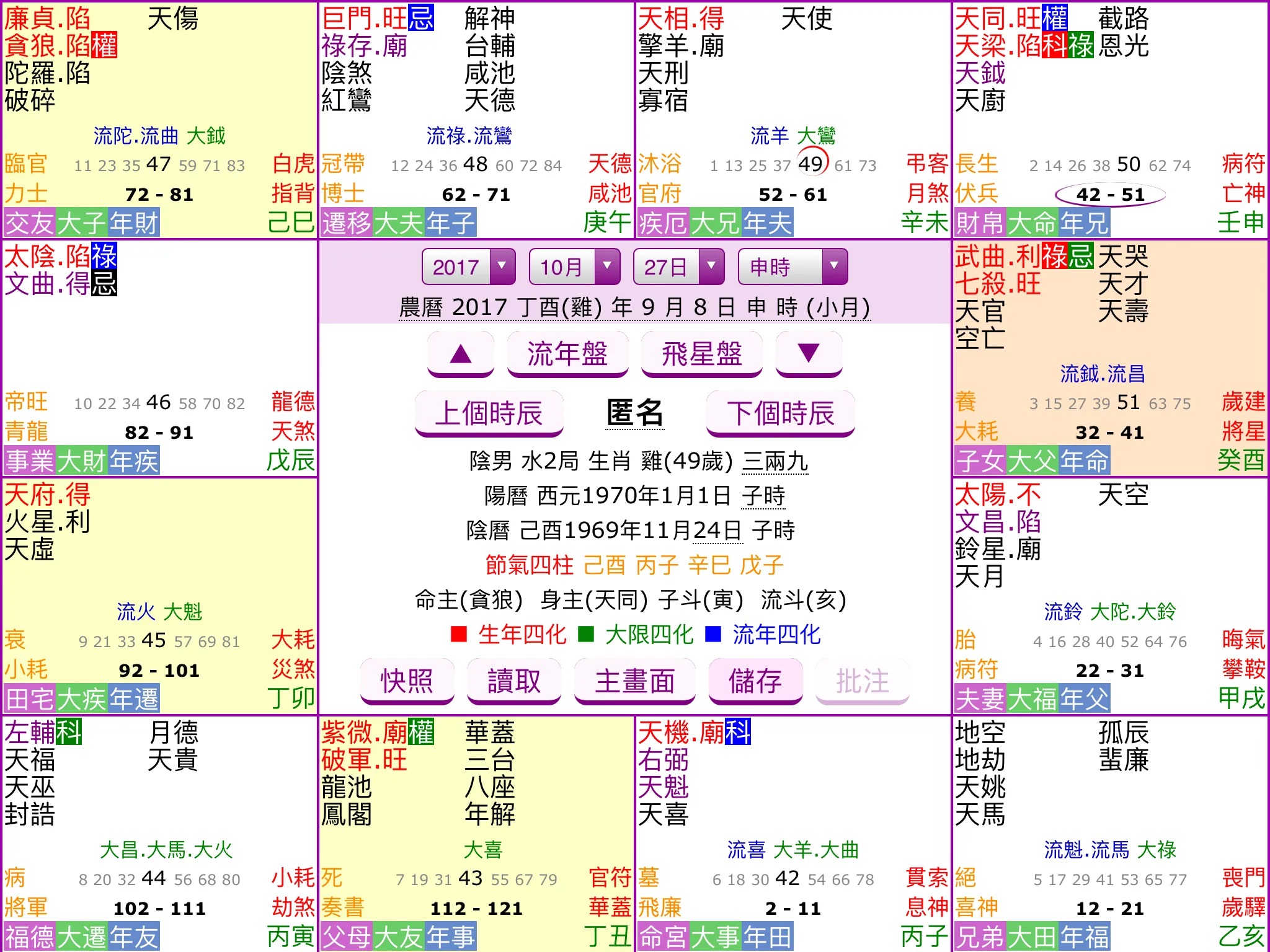
Imagine three different charts belonging to the same person (yes, three charts belong to the same person) stacked on top of each other. The complexity multiplies geometrically.
But the fascinating thing is, underlying all these complexities, is still Yin Yang & The 5 Elements, just that the application of this simple law of Yin Yang & The 5 Elements has sort of developed an emergent property, like it has a life of its own.
There are a lot of pseudo-practitioners out there who didn’t really go in-depth into their studies and are trying their ‘luck’ in this field for a career. Most of them simply read off which stars land in which Palace, which I mentioned is an extremely superficial way of analysing the chart with no benefits at all.
It doesn’t matter which method is the specialisation. A legitimate practitioner will be able to give you valuable insights into your life, as long as he or she takes this field seriously, not as a passing hobby or career experiment.
The Challenges For Zi Wei Dou Shu Learners And Clients
For Clients
Zi Wei Dou Shu is a very complex method. You’ll likely find yourself in a situation where the practitioner just says something and you have no choice but to take it at face value. However, you should ask for a technical explanation, especially when you need assurance. This serves a few important purposes:
- It lets you find out whether the practitioner knows his/her stuff: Any legitimate practitioner will be able to explain the technicals. This means that they should know all 12 possibilities of what each palace can represent and the significance of how the Four Transformers interact with the Palaces.
- You will be more assured with your reading: The last thing you want is to walk away from the consultation with doubts, and it is also your right as a customer to ask for a technical explanation, because this is the life we are talking about.
Of course, if you do ask for a technical explanation, please be polite about it, because practitioners often find themselves in situations where clients challenge them for the sake of it, and they might take it the wrong way. The practitioner has the right to reject your request, too, if you want to be nasty about it.
For Students
First, many of the good books on Zi Wei Dou Shu are in Chinese, so it will be very hard for you to access them if you are not fluent in the language. There are hardly any English books on Zi Wei Dou Shu, too, so if you’re a pure English speaker or from a Western country, it will be even more difficult.
You see other Chinese astrological methods being sold in English because they are much easier to translate and a lot quicker to monetise by turning them into courses and selling them to the masses. This will be much harder in Zi Wei Dou Shu because there are many more permutations to account for, and it takes significantly more time and effort to develop the curriculum and teach it effectively.
I hope you found this post helpful in gaining a better understanding of Zi Wei Dou Shu.
My reports are written mainly from a BaZi perspective, even though I combine both methods, because BaZi is a lot more palatable to someone new to Chinese astrology. I can break down the analysis into bite-sized pieces so the client can understand their chart. This is much more difficult in Zi Wei Dou Shu, as I’ve stated above, so it’s usually best for me to focus on what I see in the chart and not go into the technicals. I incorporate the technicals into my Zi Wei Dou Shu consultations, but only when the question calls for them.
If you have questions about Zi Wei Dou Shu, don’t hesitate to reach out!
– Sean